


Officials

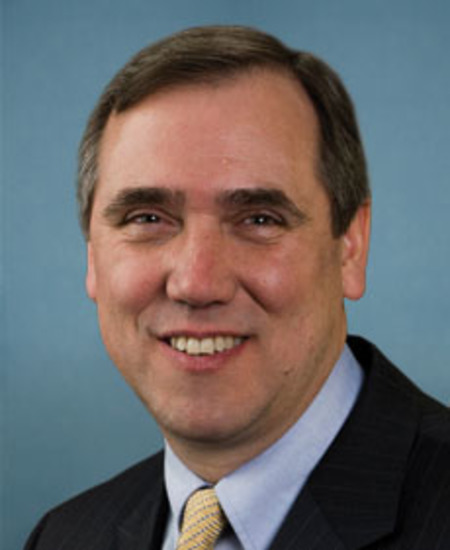
Biography
Jeffrey Alan Merkley was born on October 24, 1956, in Myrtle Creek, Oregon. He is the son of Darrell Philip Merkley, a millwright, and Betty Lou Merkley. His family moved from Douglas County to Roseburg, and later to East Multnomah County in Portland. Merkley was the first person in his family to graduate from college. He resides in East Portland with his wife, Mary Sorteberg, whom he married in 1992. They have two children, Brynne and Jonathan.
Before entering elected office, Merkley worked in public policy and nonprofit sectors. After completing his master's degree, he served as a Presidential Management Fellow at the Office of the Secretary of Defense, focusing on the security of American military technology. He subsequently worked at the Congressional Budget Office analyzing nuclear weapons policies and programs. In 1991, he returned to Portland to serve as the executive director of Portland Habitat for Humanity until 1994. During this time, he initiated projects such as the Walk for Humanity and a pilot project for YouthBuild. He later served as Director of Housing Development at Human Solutions and was president of the World Affairs Council of Oregon for seven years.
Education
Merkley attended first grade in Roseburg, Oregon, and graduated from David Douglas High School in Portland. He pursued higher education at Stanford University, where he received a Bachelor of Arts degree in international relations in 1979. He later earned a Master of Public Affairs degree from the Woodrow Wilson School at Princeton University in 1982.
Political Experience
Oregon House of Representatives
Merkley was elected as a Democrat to the Oregon House of Representatives in 1998, representing the 16th district in east Portland, which was renumbered as the 47th district following 2002 redistricting. He served from January 3, 1999, to January 2, 2009. Following the 2003 session, he was elected Democratic leader. After House Democrats gained a majority in the 2006 statewide elections, he was unanimously elected Speaker of the House, serving from January 3, 2007, to January 2, 2009.
During his tenure as Speaker, the Oregon House passed legislation creating a state rainy day fund, increased public school and state university funding, banned junk food in schools, expanded the commercial indoor smoking ban, and revised the Oregon Bottle Bill. His leadership also oversaw laws outlawing discrimination based on sexual orientation and gender identity in housing and the workplace, as well as measures granting rights and benefits to same-sex couples.
United States Senate
Merkley announced his candidacy for the U.S. Senate on August 1, 2007. He won the Democratic nomination in 2008 and defeated two-term Republican incumbent Gordon Smith in the general election. He assumed office on January 3, 2009, serving alongside Ron Wyden. Merkley was reelected in 2014, defeating Republican nominee Monica Wehby, and again in 2020, defeating Republican nominee Jo Rae Perkins. He was the first federal candidate to be cross-nominated by the Independent Party of Oregon.
In the Senate, Merkley has been an advocate of progressivism and was the only U.S. senator to endorse Bernie Sanders in the 2016 Democratic presidential primaries. He was considered a potential candidate for president in 2020 but chose to run for reelection to the Senate instead.
Committee Assignments and Leadership
Merkley serves on several Senate committees, including the Appropriations Committee, the Environment and Public Works Committee, the Rules Committee, and the Senate Foreign Relations Committee. He is the Co-Chair of the Congressional-Executive Commission on China. His leadership roles include:
- Ranking Member of the Senate Budget Committee
- Chair of the Subcommittee on Interior, Environment, and Related Agencies
- Chair of the Subcommittee on Chemical Safety, Waste Management, Environmental Justice, and Regulatory Oversight
Merkley maintains a presence in Oregon by holding town hall conversations in each of the state's 36 counties every year.
Committees
20 assignmentsAt a glance
- Office
- US Senator
- District
- Statewide
- Born
- October 24, 1956 (69 years old)
- Mailing
- 531 Hart Senate Office Building, Washington, DC 20510