

WeVote

Bill

Bill

HF 3436

Vehicles approaching school buses required to stop for flashing red lights.

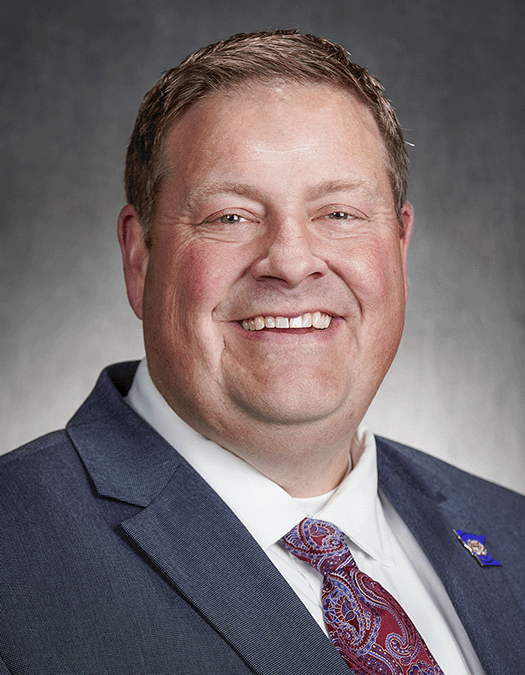
2025-2026 Regular Session Introduced by Keith Allen and 27 co-sponsors

Requires all vehicles to stop when a school bus displays flashing red lights to protect students loading and unloading.

Author added Rarick
0
WeVote Research Nonpartisan
Bill Summary · HF 3436

Summary of HF 3436 (Minnesota, 2025-2026): Vehicles Approaching School Buses Required to Stop for Flashing Red Lights

Overview

HF 3436 proposes a statutory requirement that drivers must stop for school buses when the bus displays flashing red lights. The measure aligns with traffic-safety practices intended to protect children boarding or disembarking from school buses. The bill has progressed through the Transportation Finance and Policy committee and reflects broad bipartisan sponsorship.

  • Session: 2025-2026
  • Jurisdiction: Minnesota
  • Current status in the action history: Referred to committee, with subsequent committee reports and readings; the bill has undergone comparable consideration with a Senate companion (SF 3623) and experienced standard legislative processing steps (introduction, committee referral, floor readings, and omnibus comparison).

Purpose and Intent

  • To enhance school zone safety by ensuring that motorists halt when a school bus is signaling children to load or unload.
  • To reduce the risk of collisions or near-misses involving school buses and children in high-traffic loading zones.

Key Provisions (as implied by title and standard practice)

While the provided information does not include the full text, the bill’s title indicates the core requirement:
- When a school bus displays flashing red lights, all oncoming and following vehicles must stop.
- The stop must occur at a specified distance from the bus (the standard in many jurisdictions is 20 feet for vehicles traveling in either direction on undivided roads and 20-30 feet on divided roads; Minnesota often uses a consistent stop distance of at least 20 feet in similar statutes). The bill would specify the safe stopping distance.
- Vehicles that fail to stop would face penalties (typically fines and possibly points on the driver’s license, consistent with Minnesota law for traffic infractions involving school buses).
- Provisions may address exemptions (e.g., controlled access highways, divided roads with median barriers) and operational exceptions (e.g., if the bus is on a different roadway alignment or if alternate traffic controls are in place).

Who Is Affected

  • All operators of motor vehicles traveling on public roads in Minnesota.
  • School districts, bus contractors, and school transportation staff who coordinate bus routes and enforcement.
  • Law enforcement agencies responsible for enforcing stop requirements and issuing penalties for violations.

Procedural and Timeline Aspects

  • Introduction and first reading occurred in February 2026.
  • The bill was referred to the Transportation Finance and Policy committee (common for transportation-related traffic-safety legislation).
  • A committee report noted “to adopt,” indicating a favorable position in committee at that stage.
  • It progressed through additional readings and underwent a comparison with its Senate companion (SF 3623) on March 12, 2026.
  • A broad list of authors and co-sponsors reflects wide legislative support across multiple districts.

Potential Impacts

  • Improved safety for school-age children around bus loading/unloading zones.
  • Increased compliance burden on drivers, particularly in areas with frequent bus stops or high traffic volumes.
  • Potential need for public awareness campaigns and driver education to ensure understanding of stop requirements.
  • Possible adjustments to penalties and enforcement practices to balance deterrence with practical compliance.

Notable Details and Considerations

  • The bill has multiple co-sponsors from across districts, indicating broad legislative backing.
  • The action history shows standard legislative process: introduction, committee consideration, readings, and comparison with the Senate version.
  • Specific enforcement mechanisms, penalties, and exact distances are expected to be detailed in the bill text or accompanying amendments.

If you’d like, I can extract and summarize the exact statutory language, proposed penalties, or any fiscal implications once the full text is available.

Compiled from official sources — confirm details with the bill’s official record.

Sign in to ask a question.