

WeVote

Bill

Bill

HF 2390

Southeast Minnesota Workforce Development Area grant funding provided, report required, and money appropriated.

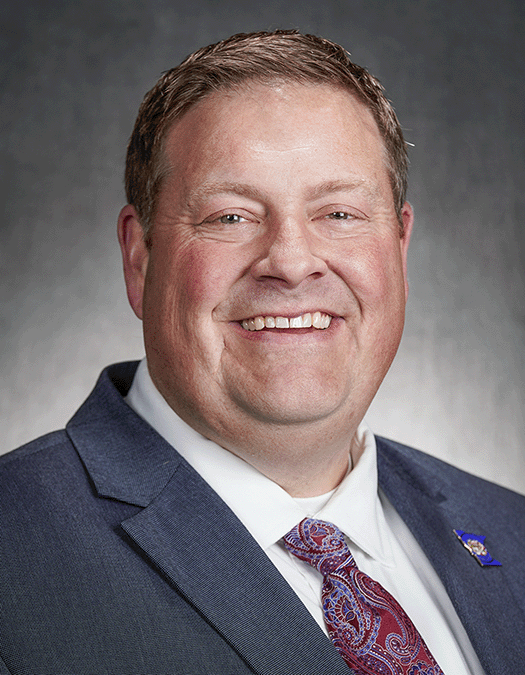
2025-2026 Regular Session Introduced by Keith Allen and 4 co-sponsors

Provides grant funding for Southeast Minnesota's Workforce Development Area and requires reporting on use and outcomes, boosting local job training and employment opportunities.

Introduction and first reading, referred to Workforce, Labor, and Economic Development Finance and Policy
0
WeVote Research Nonpartisan
Bill Summary · HF 2390

Summary of HF 2390 (Southeast Minnesota Workforce Development Area Grant Funding)

Overview

HF 2390 is a proposed Minnesota House bill introduced on March 17, 2025. The bill, currently at the introduction and first-reading stage, seeks to provide grant funding for the Southeast Minnesota Workforce Development Area, requires a reporting element, and appropriates money to support workforce development initiatives. It has a companion bill in the Senate, SF 2461.

  • Status: Introduction and first reading; referred to the committee on Workforce, Labor, and Economic Development Finance and Policy
  • Introduced: March 17, 2025
  • Companion: SF 2461

Purpose and Intention

The bill appears designed to enhance workforce development in Southeast Minnesota by providing targeted grant funding to support workforce initiatives within the Southeast Minnesota Workforce Development Area. It also establishes a reporting requirement to track funding use and outcomes, enabling legislative oversight and program accountability. The overarching aim is likely to strengthen job training, education-to-employment pathways, and related services in the region, contributing to local economic development and labor market outcomes.

Key Provisions (as indicated by the bill's title and summary)

  • Grant funding for Southeast Minnesota Workforce Development Area: The bill would authorize and provide grants to support workforce development activities within the Southeast Minnesota LWDA.
  • Appropriation of funds: The bill would authorize the appropriation of state funds dedicated to these grants and related activities.
  • Reporting requirement: The bill would require preparation and submission of a report detailing the use of funds, program activities, and presumably outcomes or metrics associated with the grant program.
  • Affected programs and agencies: Likely involves coordination across the Minnesota Department of Employment and Economic Development (DEED) and potentially the Department of Labor and Industry (DLI) or related labor and employment agencies, as reflected in the bill’s subject classification (appropriations, employment/development, labor and industry).

Affected Parties and Impacts

  • Southeast Minnesota Workforce Development Area: Primary beneficiary, receiving grant funding to support workforce development initiatives.
  • Local workforce development providers and partners: Potential recipients and program operators (training providers, employers, community organizations, and economic development partners).
  • State agencies: DEED and possibly the Department of Labor and Industry (DLI) may implement and oversee the program, administer grants, and fulfill reporting requirements.
  • Employers and workers in Southeast Minnesota: Expected indirect beneficiaries through enhanced training opportunities, targeted programs, and improved workforce readiness.

Procedural and Timeline Aspects

  • Introduction and referral: The bill was introduced and referred to the Workforce, Labor, and Economic Development Finance and Policy committee on March 17, 2025.
  • Next steps: The bill would advance through committee consideration, potential amendments, and floor action. As a companion, SF 2461 will be tracked for parallel Senate action.
  • Text specifics: The provided information does not include the bill’s full text or numeric funding amounts, schedule, or detailed reporting standards. The exact program design, grant criteria, duration, and reporting format would be clarified in the bill’s draft language and any fiscal notes.

How to Follow

  • Monitor HF 2390’s progression in the House; check committee hearings for amendments and fiscal notes.
  • Review the companion SF 2461 for Senate alignment and strategy.
  • Read the bill text when available for explicit grant criteria, funding levels, reporting requirements, and performance metrics.

Compiled from official sources — confirm details with the bill’s official record.

Sign in to ask a question.