

WeVote

Bill

Bill

HF 5015

School safety plans enhanced, student discipline provisions modified, anonymous reporting systems enabled, safe schools revenue increased, school building and cybersecurity grant program modified, reports required, and money appropriated.

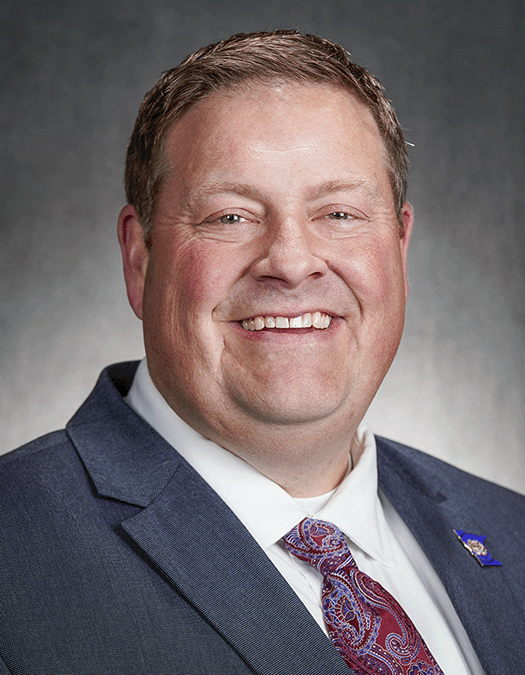
2025-2026 Regular Session Introduced by Keith Allen and 32 co-sponsors

Strengthens Minnesota K-12 safety by creating a model evidence-based school safety plan, plus anonymous threat reporting, enhanced support services, and targeted funding.

Motion did not prevail
0
WeVote Research Nonpartisan
Bill Summary · HF 5015

Summary of HF 5015 (2025-2026) – Minnesota

HF 5015, introduced in the Minnesota House of Representatives, seeks to enhance school safety, modify student discipline provisions, enable anonymous reporting systems, increase safe schools revenue, and adjust related grant programs and reporting requirements. The bill includes appropriations and transfers to support these initiatives and repeals a prior statute related to discipline.

1) Purpose and Intent

  • Strengthen the framework for preventing and responding to safety incidents in K-12 schools.
  • Encourage adoption of evidence-based school safety plans by school boards and improve consistency across districts.
  • Establish and/or promote anonymous reporting systems to promptly identify and address threats or safety concerns.
  • Increase Safe Schools Revenue to support safety, counseling, security, and related services.
  • Modify the school building and cybersecurity grant program to better address current needs and provide targeted funding.
  • Require routine reporting and provide new or reallocated funding streams to support these efforts.

2) Key Provisions and Changes

A. School Safety Plans (Section 1)

  • The Minnesota School Safety Center must:
    • Develop an evidence-based model school safety plan for school boards to adopt.
    • Create criteria to determine if plans are evidence-based.
    • Review local school safety plans and notify districts whether they meet requirements.
    • Assess whether facility improvements are evidence-based.
    • Administer grants to implement evidence-based plans (as funds allow).
    • Publish a report listing schools with evidence-based plans; update every two years (initial update by Dec 1, 2028).
  • Subdivision 2 defines “evidence-based” using rigorous criteria (experimental, quasi-experimental, or high-quality correlational evidence, plus ongoing evaluation).
  • A model plan will be posted by Sept 1, 2026; third-party plans may be used.
  • Local adoption deadline: May 1, 2028 (with follow-up in May of subsequent years).
  • Encourages nonpublic schools to engage with the model plan.

B. Anonymous Threat Reporting System (Section 2)

  • Establishes a framework for local anonymous threat reporting:
    • 24/7 anonymous reporting via app and multilingual crisis center.
    • Crisis centers staffed by trained personnel; rapid forwarding to appropriate school teams.
    • Coordinated response with 911 and law enforcement as needed.
    • School-based teams trained to receive notices; public awareness prior to launch.
    • Evidence-based violence prevention training for students; guidance on reporting self-harm risks.
    • Data practices compliance (state and federal privacy laws).
  • If a district contracts with a third party, additional requirements apply (website and toll-free hotline).
  • Districts must report to the Department of Education on implementation, providers, contacts, and report counts (including false reports).
  • Statewide system information and annual reporting on totals and disaggregated data starting from 2027 onward.
  • Funding: districts may seek funding from public or private sources; existing state resources to be used where possible.
  • Effective date: July 1, 2026.

C. Discipline Provisions (Section 3)

  • Amends Section 121A.425 to tighten rules around disciplinary dismissals:
    • Certain early childhood and K-3 students may not be dismissed for more than one school day; expulsions/exclusions only after exhaustion of resources and under ongoing safety threat conditions.
    • Overall emphasis on non-discriminatory, supportive approaches before dismissal/expulsion.

D. Safe Schools Revenue and Uses (Sections 4-5)

  • Reforms and clarifies uses of Safe Schools Revenue (capital and programmatic uses), including:
    • Hiring and expanding student support services staff (counselors, school nurses, social workers, psychologists, etc.).
    • Funding for cybersecurity, security improvements, and school climate initiatives.
    • Allows use for contracted services if needed to meet staffing requirements.
  • Caps and transfer mechanisms for funding to cooperative units or intermediate districts.
  • Caps and allowances for administrative costs and flexibility in using funds for related purposes.
  • Effective for revenue and operations in fiscal years 2027 and beyond (with some provisions for nonpublic and tribal contract schools).

E. School Safety Facility Grants (Section 7)

  • Authority to award school safety facility grants up to $500,000 per qualifying school.
  • Priority given to non-Metropolitan-area schools; construction funds disbursed after bid and project readiness documentation.
  • Effective upon final enactment.

F. Appropriations and Repeals (Sections 6, 9, 10)

  • Repeals Minnesota Statutes 121A.425, subdivision 2.
  • Transfers and appropriations include:
    • Safe schools aid: $44,588,000 for 2027 (no 2026 funding in this bill).
    • School safety facility grants: $50,000,000 for 2027 (one-time, available until 2029).
    • Minnesota School Safety Center: $500,000 (one-time, for 2027).
    • School-linked behavioral health grants: $2,500,000 (for 2027).
  • Some existing capital project appropriation for the Minneapolis-Duluth rail project is canceled ($50 million).

3) Who/What Is Affected

  • Minnesota school districts, charter schools, cooperative units, nonpublic schools, and Tribal contract schools.
  • Students, staff, and families through enhanced safety planning, anonymous reporting, discipline processes, and expanded access to supportive services.
  • Local law enforcement and 911 partners via integrated response capabilities.
  • Minnesota Department of Education and Minnesota Department of Public Safety (via the School Safety Center) in modeling, reporting, and system coordination.

4) Timeline and Process

  • Model safety plan published by Sept 1, 2026; local plan adoption deadlines by May 1, 2028.
  • Anonymous threat reporting system requirements effective July 1, 2026; ongoing reporting to DOE starting 2027.
  • Revenue and grant program changes apply to fiscal years 2027 and later.
  • Repealer takes effect July 1, 2026.
  • Several appropriations are one-time and expire by mid to late 2029, with ongoing programmatic responsibilities.

This bill represents a comprehensive approach to school safety, combining model planning, local implementation, anonymous reporting, discipline reform, and expanded funding for safety and mental health supports, along with updated grant programs and reporting requirements.

Compiled from official sources — confirm details with the bill’s official record.

Sign in to ask a question.