

WeVote

Bill

Bill

HF 2387

School food waste reduced, free school milk provided without the need to take full school lunch, and money appropriated.

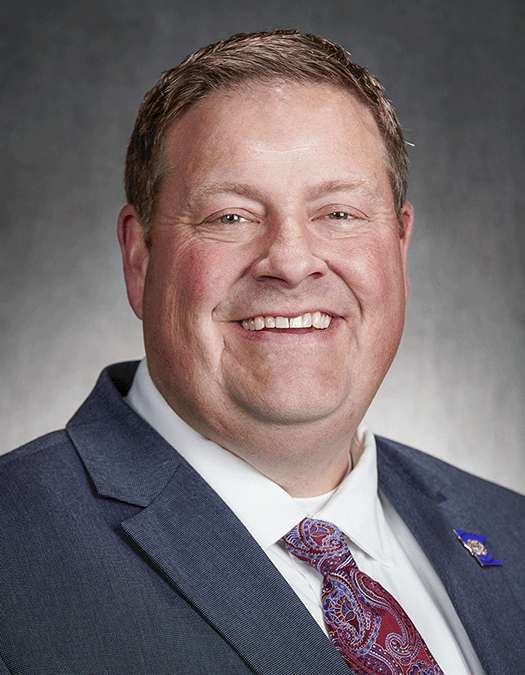
2025-2026 Regular Session Introduced by Keith Allen and 18 co-sponsors

The bill aims to improve school nutrition by allowing free milk for eligible students without requiring a full lunch and by reducing school meal waste.

Author added Kraft
0
WeVote Research Nonpartisan
Bill Summary · HF 2387

Summary of HF 2387 (2025-2026) – Minnesota

Purpose and intent

HF 2387 seeks to reform school food programs with three core objectives:
- Reduce school lunch-related food waste.
- Provide free school milk to eligible students without requiring them to take a full school lunch.
- reallocate or appropriate funds to support these changes.

The bill appears to be focused on improving meal program efficiency, increasing student access to free milk, and minimizing waste within school food services.

Key provisions and changes (as implied by title and typical bill structure)

Note: The exact text of provisions is not provided here, so the following reflects the bill’s stated aims and common policy mechanisms used in similar legislation.

  • School food waste reduction

    • Implement measures to identify, monitor, and reduce the amount of food discarded in school meal programs.
    • Possibly allocate funding or establish standards/programs targeted at waste reduction (e.g., plate waste tracking, meal customization options, or procurement changes).
  • Free school milk without requiring a full school lunch

    • Allow eligible students to receive free or reduced-cost milk without the prerequisite of taking a full school lunch.
    • Create eligibility criteria and administrative processes for milk-only access.
    • Align milk program with existing free/reduced-price meal frameworks or separate entitlement mechanisms.
  • Funding and appropriations

    • Designate funds to support the above initiatives, which may include:
    • Program administration and outreach.
    • Costs for additional milk provision (if current milk budgets are insufficient for broader access).
    • Waste reduction programs (tracking systems, staff training, and meal-planning improvements).

Who would be affected

  • Students: Especially those who benefit from free milk access without having to participate in a full lunch; potentially more students could receive milk as part of daily school meals.
  • School districts and food service departments: Responsible for implementing waste-reduction strategies, administering milk-only eligibility, and managing any associated funding.
  • State education and health/food programs: Likely involved in policy alignment, reporting, and oversight of program compliance and data collection.

Procedural and timeline aspects

  • Introduction and first reading occurred on March 17, 2025, with referrals to Education Finance, indicating initial committee consideration and fiscal analysis.
  • The bill lists a broad set of sponsors, suggesting cross-cutting support from multiple districts and stakeholders.
  • As a House file in Minnesota, typical steps would include committee hearings (Education Finance or related committees), potential amendments, floor debate, and votes before advancing to the Senate.

Potential impacts and considerations

  • Accessibility and equity: By decoupling milk access from full meals, more students may obtain dairy nutrition, potentially improving calcium intake and school-day nutrition.
  • Administrative burden: Schools may need new processes to track milk-only eligibility and to report waste-reduction metrics; budget adjustments may be required for milk provisioning.
  • Fiscal impact: The appropriations component will determine the scale of state funding, the number of students covered for milk, and the intensity of waste-reduction activities.
  • Waste reduction outcomes: Success depends on concrete targets, data collection methods, and collaboration with districts to implement proven waste-minimizing practices.

If you have access to the full bill text, I can provide a more detailed, clause-by-clause summary and quantify fiscal impacts, timelines, and reporting requirements.

Compiled from official sources — confirm details with the bill’s official record.

Sign in to ask a question.