

WeVote

Bill

Bill

HF 165

Sales tax refunds provided for qualifying individuals.

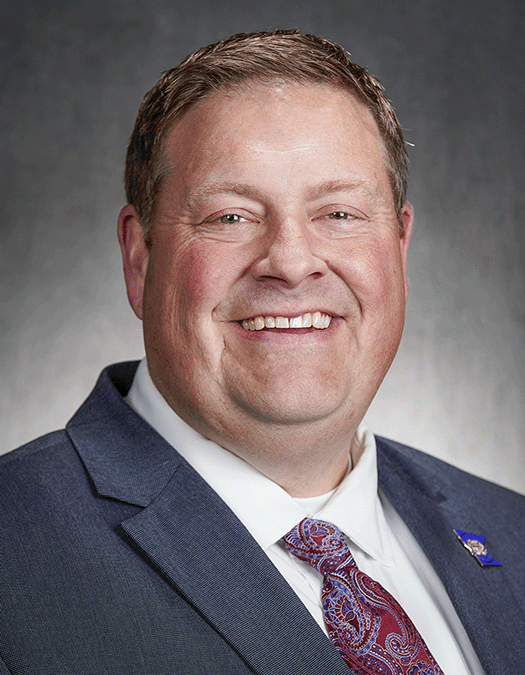
2025-2026 Regular Session Introduced by Keith Allen and 3 co-sponsors

Requires public high school students to pass the USCIS civics test to graduate, starting 2026-27, with accommodations and annual reporting.

Introduction and first reading, referred to Taxes
0
WeVote Research Nonpartisan
Bill Summary · HF 165

Summary — HF 165 (as amended by H‑1229)

Note: Although the bill caption lists “Sales tax refunds,” the operative text (as amended H‑1229, adopted 4/17/2025) addresses civics testing and high school graduation/equivalency requirements.

Purpose

Require students to pass a civics assessment based on the U.S. Citizenship and Immigration Services (USCIS) naturalization civics test as a condition of receiving a public high school diploma, and to require the same test be passed by persons receiving a state high‑school equivalency diploma.

Key provisions

  • Test content and distribution

    • The Department of Education (DE) must develop and distribute to school districts, accredited nonpublic schools, charter schools, and innovation zone schools a multiple‑choice test consisting of all questions in the most recent USCIS civics test.
    • DE must update and redistribute the test on or before January 31 following each presidential general election.
  • Graduation requirement

    • Commencing with the 2026–27 school year (school year beginning July 1, 2026), each local public school board and authorities in charge of accredited nonpublic schools must administer the DE‑distributed test in written or electronic form to students in grades 9–12.
    • Students must achieve a passing score (at least 60% correct) at least once as a condition of high school graduation.
    • Students who have already passed the test are exempt from additional administration.
    • Students who fail may retake the test as often as necessary.
  • Equity and accommodations

    • No fees may be imposed or collected by schools for administering the test.
    • Boards/authorities may modify the test for students with an IEP or 504 plan, develop alternate tests for students with significant intellectual disabilities, and modify for English learners.
    • The State Board of Education shall adopt rules to administer the requirement.
  • Reporting and study

    • Each district and accredited nonpublic school must submit test results to the DE on or before June 30 annually.
    • DE must study the relationship between high school graduation rates and the number of students who attain a passing score and report results to the General Assembly by June 30, 2029. That study requirement is repealed July 1, 2029.
  • High‑school equivalency diplomas

    • The department’s high school equivalency diploma issuance criteria are amended to require passing the same civics test.
  • Applicability

    • The requirement begins with the school year starting July 1, 2026.

Who is affected

  • Students enrolled in grades 9–12 in public school districts and accredited nonpublic schools in Iowa.
  • Individuals seeking a state high‑school equivalency diploma.
  • Local school boards, nonpublic school authorities, charter and innovation zone schools (subject to compliance clauses).
  • The Department of Education (administration, distribution, updates, data collection, and the 2029 study).

Timeline & procedural notes

  • Effective for school years beginning on or after July 1, 2026.
  • DE must update distributed test after each presidential general election by Jan 31.
  • Annual results due to DE by June 30 each year.
  • Study/report to General Assembly due June 30, 2029; study statute repealed July 1, 2029.

Legislative status and related bills

  • Introduced Jan 30, 2025; referred to Taxes.
  • Multiple amendments filed; amendment H‑1229 (adopted 4/17/2025) is the controlling amendment.
  • Companion bill: SF 954.
  • Other amendments (H‑1007, H‑1078) were filed but later withdrawn.

Potential impacts and considerations

  • Administrative burden on schools for test administration, reporting, and accommodations.
  • Potential effects on graduation rates, especially for students with limited English proficiency or significant disabilities — the bill builds in accommodations but outcomes will depend on implementation.
  • No testing fee removes direct cost barrier to students.
  • Requiring the USCIS civics test aligns K–12 assessment to a federal naturalization test; curricular alignment and teacher preparation will be important for students to meet the 60% threshold.

Compiled from official sources — confirm details with the bill’s official record.

Sign in to ask a question.