

WeVote

Bill

Bill

E 1626

Relates to a plan setting forth an itemized list of grantees for the New York State Capital Assistance Program

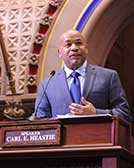
2025 Regular Session Introduced by Carl Heastie

The bill updates and formalizes the Capital Assistance Program’s itemized grant list, detailing grantees and amounts to authorize current CAP funding.

ADOPTED
0
WeVote Research Nonpartisan
Bill Summary · E 1626

Summary of Bill E 1626 (2025-2026) – New York

Purpose and intent

  • This Assembly bill amends previously adopted resolutions to set forth an itemized list of grantees for the New York State Capital Assistance Program (CAP), established in 2008.
  • The CAP is funded through appropriations and is designed to support capital projects across a wide range of cultural, educational, health, community, and infrastructure initiatives in New York State.
  • The bill’s core function is to formalize and update the plan showing who receives CAP grants, effectively approving a detailed schedule of grants and corresponding amounts as part of ongoing CAP funding.

Key provisions and changes

  • Reaffirms that the CAP operates under the framework created by:
    • Part QQ of Chapter 57 of the Laws of 2008 (Education, Labor and Family Assistance Budget)
    • Section 5 of Chapter 53 of the Laws of 2008 (enacting CAP-related budget provisions)
  • Establishes an itemized grant list (grantees and dollar amounts) to be used for CAP appropriations, as adopted by:
    • Assembly Resolution 2002 of 2008
    • As amended by subsequent Assembly resolutions (1603 of 2016; 445 of 2021; 1074 of 2022; 715 of 2023; 821 of 2025)
  • The bill confirms a specific total appropriation amount (noted in the document as a bracketed figure [340,545,000] transitioning to [344,200,000], signaling a current total CAP funding level in this plan). The exact total reflects the planned CAP disbursement for the listed projects.
  • Provides an enumerated list of grantees, organizations, and projects across various sectors, including but not limited to:
    • Health care facilities (e.g., Albany Medical Center, Montefiore Medical Center, Morris Heights Health Center, etc.)
    • Cultural and arts institutions (e.g., El Museo del Barrio, Lincoln Center, Carnegie Hall, Jewish Museum, Brooklyn Academy of Music, Queens Museum of Art, etc.)
    • Libraries and museums (e.g., Brooklyn Public Library, Queens Borough Public Library, New York Public Library foundations)
    • Educational and community organizations (e.g., Bank Street College, The Educational Alliance, SUNY and university-related projects)
    • Municipal and regional development projects (e.g., City of Buffalo neighborhood renewal, Inlet Dredging in Ithaca, flood mitigation projects, park and recreation improvements)
    • Economic and incubator initiatives (e.g., Centerstate Corporation for Economic Opportunity, Cortland Downtown Partnership incubator)
    • Other infrastructure, historic preservation, and cultural heritage initiatives
  • The list includes project-specific amounts, with some multi-project organizations receiving several separate grants (e.g., Morris Heights Health Center appears with multiple line items; City of Middletown appears with two entries; The Brooklyn Queens Conservatory of Music appears in two entries, etc.).

Who would be affected

  • Recipients of CAP grants: a broad array of organizations and government entities across New York State, including:
    • Hospitals, health centers, and medical research/educational facilities
    • Museums, cultural institutions, libraries, and performing arts organizations
    • Colleges, universities, and related education-focused foundations
    • City, town, and county governments pursuing capital projects (infrastructure, flood mitigation, parks, and public facilities)
    • Nonprofits and cultural/arts organizations receiving capital assistance to renovate, expand, or build facilities
  • Program administrators and policymakers: state budget offices, the Assembly (and its Ways and Means Committee) to maintain and approve the itemized plan; local governments and organizations to align with CAP funding cycles.

Procedural and timeline aspects

  • The bill is a refinement of an established CAP plan, updating the itemized list of grantees as required by law (CAP framework established in 2008 and amended in subsequent resolutions).
  • Action history indicates:
    • Referred to Ways and Means (June 4, 2026)
    • Reported to Rules and Rules calendar for consideration; adopted by the Assembly (June 5, 2026)
  • The resolution is part of the legislative process to approve the CAP grant plan for the current and upcoming fiscal periods, aligning with the budgetary allocations authorized in prior CAP-related statutes.

Additional notes

  • The document lists a comprehensive set of grantees with specific grant amounts, illustrating the breadth of the CAP’s impact on cultural, educational, health, and community development across New York State.
  • No explicit policy changes beyond updating and approving the itemized grant list; the bill functions to authorize and codify the current CAP grant allocations as adopted by the listed resolutions.

Compiled from official sources — confirm details with the bill’s official record.

Sign in to ask a question.