

WeVote

Bill

Bill

HF 1339

Public employees police and fire retirement plan; payment of a normal retirement annuity without reduction or suspension upon employment or reemployment on or after 55 years of age permitted.

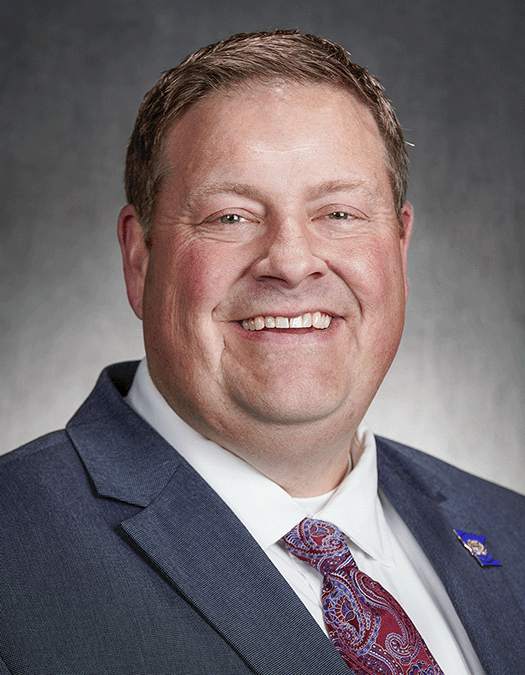
2025-2026 Regular Session Introduced by Keith Allen and 8 co-sponsors

Allows retirees to receive a full normal retirement annuity without reduction when employed or reemployed after age 55 in any role covered by the plan.

Author added Warwas
0
WeVote Research Nonpartisan
Bill Summary · HF 1339

Summary of HF 1339 (2025-2026) — Public Employees Police and Fire Retirement Plan

Purpose and Intent

HF 1339 proposes to modify the Public Employees Police and Fire Retirement Plan (P.E. P&F Plan) by allowing a retiree to receive a normal retirement annuity without reduction or suspension when they are employed or reemployed in any capacity on or after reaching age 55. The bill aims to provide greater flexibility for retirees who wish to return to work, potentially in public safety or related roles, without forfeiting their retirement benefits.

Key Provisions

  • Normal retirement annuity unaffected by subsequent employment after age 55:
    The bill authorizes payment of a normal retirement annuity to a retiree who becomes employed or reemployed on or after the age of 55, with no reduction or suspension of the retirement benefit due to the employment.

  • Scope of employment:
    The language indicates the provision applies to employment or reemployment (the bill does not specify limitations to particular job titles within policing and firefighting; the intent appears to cover any form of employment in governmental or related roles that are within the plan’s purview).

  • Implementation framework:
    The bill does not currently include detailed administrative rules within the provided summary, but would presumably require amendments to the plan’s governing statutes and related administrative procedures to ensure eligibility, offset considerations (if any), and compliance with pension funding rules.

Who Is Affected

  • Retirees of the Public Employees Police and Fire Retirement Plan:
    Individuals who have already earned a normal retirement benefit and who later seek employment or reemployment on or after age 55 could continue receiving their full retirement annuity without reductions.

  • Public sector employers covered by the P.E. P&F Plan:
    Agencies and departments that hire former police or fire personnel who are within the scope of the plan would be affected in terms of payroll administration and coordination with pension payments.

  • Plan administrators and the Minnesota retirement system:
    Administrative processes, eligibility verification, and potential financial implications for pension funding and actuarial soundness would be impacted, necessitating guidance or updates to policies and procedures.

Procedural and Timeline Aspects

  • Introduction and first reading:
    HF 1339 was introduced and referred to the State Government Finance and Policy committee on February 24, 2025.

  • Sponsorship:
    The bill lists multiple sponsors and co-sponsors, including primary sponsor(s) and a broad group of cosponsors (e.g., Cal Warwas, Natalie Zeleznikar, Tom Sexton, Paul Novotny, Bidal Duran, Keith Allen, Terry Stier, Erica Schwartz, Ripper Repinski).

  • Subsequent steps (typical for this process):
    If advanced, the bill would move through additional committee hearings, potential amendments, floor debates, and votes in the Minnesota House of Representatives, followed by potential Senate consideration and final passage, subject to legislative timelines.

Potential Impacts and Considerations

  • Financial Implications:
    Paying full normal retirement benefits while the retiree is employed could affect the plan’s cash-flow, funding requirements, and actuarial assumptions. The bill would likely prompt a review of the plan’s funding status and any necessary actuarial adjustments.

  • Policy Implications:
    The change could influence workforce planning for police and fire departments, allowing experienced retirees to return to service without penalty, which may affect recruitment, retention, and service continuity.

  • Administrative Considerations:
    Clear rules would be needed to prevent abuse, define eligible employment types, and establish any necessary limits (e.g., hours worked, positions, or duration) if they apply.

If you’d like, I can tailor this summary to include hypothetical fiscal estimates, potential amendments, or a side-by-side comparison with current law to illustrate how HF 1339 would change the existing framework.

Compiled from official sources — confirm details with the bill’s official record.

Sign in to ask a question.