

WeVote

Bill

Bill

HF 3822

Penalty for misconduct of public officer or employee enhanced.

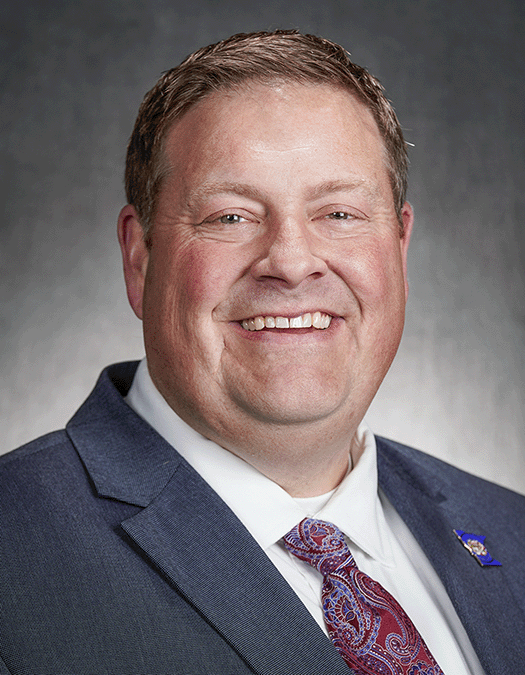
2025-2026 Regular Session Introduced by Keith Allen and 12 co-sponsors

HF3822 creates a baseline felony for public misconduct when no other sentence exists, with up to 1 year or $5,000 (first offense) and up to 5 years or $10,000 for repeat offenses.

Author added Stier
0
WeVote Research Nonpartisan
Bill Summary · HF 3822

Summary of HF3822 (2025-2026) — Penalty for Misconduct of Public Officer or Employee Enhanced

Purpose and Intent

HF3822 proposes to strengthen penalties under Minnesota Statutes for misconduct by public officers or employees when no other specific sentence is provided by law. The bill updates and expands the existing penalties to increase accountability for misconduct such as failure to perform mandatory duties, exceeding authority, causing unlawful harm under color of authority, or submitting false official documents. The effective date is August 1, 2026, with applicability to crimes committed on or after that date.

Key Provisions

  • Current statute amended: Minnesota Statutes, section 609.43 (Misconduct of Public Officer or Employee).

  • New baseline penalty (paragraph a):

    • A public officer or employee who, for which no other sentence is specified by law, commits one of the listed acts is guilty of a felony and may be sentenced as provided in subsections (b) and (c) (see below).
    • The listed acts (examples) include: 1) Intentionally fails or refuses to perform a known mandatory, nondiscretionary, ministerial duty within the required time or manner. 2) In capacity as a public officer/employee, does an act knowing it is in excess of lawful authority or forbidden by law. 3) Under pretense or color of official authority, intentionally and unlawfully injures another person, property, or rights. 4) In capacity as a public officer/employee, makes a false return, certificate, official report, or similar document with knowledge of the material falsity.
  • New penalties (paragraphs b and c):

    • Subsection (b): If a person violates paragraph (a), sentence may be imprisonment for up to 1 year or a fine of up to $5,000, or both.
    • Subsection (c): If a person violates paragraph (a) a second or subsequent time, sentence may be imprisonment for up to 5 years or a fine of up to $10,000, or both.
  • Effective date and applicability:

    • The act takes effect on August 1, 2026.
    • Applies to crimes committed on or after that date.

Who/What is Affected

  • Public officers and employees in Minnesota (state, county, city, and other public entities) who commit the listed misconducts, when no other legal sentence is provided by law for the offense.
  • The statute targets both first-time and repeat offenses, with enhanced penalties for second or subsequent violations.

Procedural and Timeline Aspects

  • Introduction and referral: The bill was introduced in the 94th Legislature (2025-2026), with initial posting in February 2026 and first reading/refer to Public Safety Finance and Policy in March 2026.
  • Status: Sponsored and awaiting further committee action; multiple co-sponsors listed.
  • Effective date: August 1, 2026 (future), with applicability to offenses committed on or after that date.

Potential Impacts

  • Deterrence and accountability: Higher potential penalties, including up to 5 years’ imprisonment for repeat misconduct, may deter misconduct by public officers and employees.
  • Clarity on penalties: The bill clarifies and strengthens the consequences for acts of official misconduct when no other sentence is specified by law.
  • Fiscal considerations: Increased penalties may influence court caseloads and related enforcement costs; however, the bill does not specify new funding or enforcement mechanisms.
  • Implementation: Agencies and prosecutors would need to apply the revised penalties starting August 2026, ensuring that charges align with the new statutory framework.

Overall, HF3822 seeks to elevate accountability for certain acts of public misconduct by increasing the possible penalties and establishing a clear baseline for offenses not otherwise prescribed by statute.

Compiled from official sources — confirm details with the bill’s official record.

Sign in to ask a question.