

WeVote

Bill

Bill

HF 4757

Method in which Pollution Control Agency ranks multicommunity projects for the point source implementation grant program adjusted.

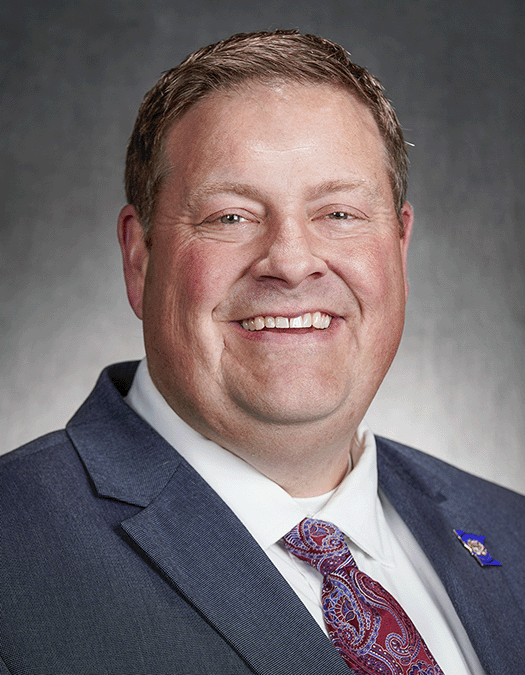
2025-2026 Regular Session Introduced by Keith Allen and 2 co-sponsors

When multiple governments join a regional project, PCA ranks it at the highest ranking position among participating units.

Introduction and first reading, referred to Capital Investment
0
WeVote Research Nonpartisan
Bill Summary · HF 4757

Summary of HF 4757 (2025-2026) — Minnesota

Overview

HF 4757 proposes a clarifying adjustment to how the Pollution Control Agency (PCA) ranks multicommunity, or regional, projects within Minnesota’s Point Source Implementation Grant program. The bill adds a new subdivision to Minnesota Statutes 2024, section 446A.073, to ensure that when multiple governmental units collaborate on a joint project, the ranking for funding prioritization uses the position of the highest-ranking unit among those participants. The practical effect is that the joint project would be treated as if it occupies the highest priority ranking of any participating unit when placed on the PCA’s project priority list.

  • Official title (summary): An act relating to capital investment; adjusting how PCA ranks multicommunity projects for the point source implementation grant program; amending § 446A.073 by adding a subdivision.
  • Session: 94th Legislature (2025-2026)
  • Bill number: HF 4757
  • Introduced / Status: Introduced and referred to Capital Investment on March 26, 2026
  • Sponsors:
    • Primary: (not listed)
    • Co-sponsors: Pam Altendorf, Steve Jacob, Keith Allen

Main Purpose and Intent

  • To modify the project ranking methodology used by the PCA for multigovernmental-unit projects funded through the Point Source Implementation Grant program.
  • Specifically, to ensure that when multiple governmental units participate in a single regional project, the project’s ranking on the PCA’s priority list reflects the highest ranking achieved by any single governmental unit involved. In other words, the entire regional project would be treated as if it occupies the priority position of the highest-ranked participant.

Key Provisions

  • New subdivision added to § 446A.073 (Subd. 6 — Regional projects).
    • When multiple governmental units engage in a joint project, the PCA must determine the project’s rank by considering where each unit would rank individually.
    • The regional project’s total ranking on the PCA’s project priority list should be placed at the position of the highest-ranking governmental unit among the participants.

Affected Parties

  • Primary regulatory/administrative body: Minnesota Pollution Control Agency (PCA)
  • Participating entities: Any combination of local governments or governmental units jointly undertaking a multicommunity (regional) project that is eligible for Point Source Implementation Grant funding.
  • Potentially affected by funding outcomes: Local governments and regional entities coordinating projects related to pollution control, water quality, wastewater infrastructure, and other point-source pollution control measures that rely on PCA grant rankings.

Procedural and Timeline Aspects

  • Effective upon enactment: The bill’s changes would apply when the new subdivision is in effect and used by the PCA to rank projects for grant funding.
  • Legislative process: The bill was introduced and referred to the Capital Investment committee on March 26, 2026. It has co-sponsors, indicating cross-chair or cross-party support, though no fiscal note or committee actions beyond introduction are provided in the summary.

Potential Implications

  • Funding prioritization: Could alter which regional projects receive priority for Point Source Implementation Grants by aligning their ranking with the highest priority unit involved, potentially increasing or decreasing funding likelihood depending on the composition of participating units.
  • Equity and coordination: Creates a clear rule for handling regional projects, potentially simplifying ranking processes and promoting collaboration across jurisdictions to maximize priority placement.
  • Administrative clarity: Reduces ambiguity for the PCA when evaluating multijurisdictional projects by standardizing ranking methodology.

If you would like, I can translate this into a plain-language one-page briefing for non-specialist readers or add a comparison to the current ranking method (before this subdivision) for context.

Compiled from official sources — confirm details with the bill’s official record.

Sign in to ask a question.