

WeVote

Bill

Bill

HF 3683

Inclusions of the impacts of fraud in budget forecasts required.

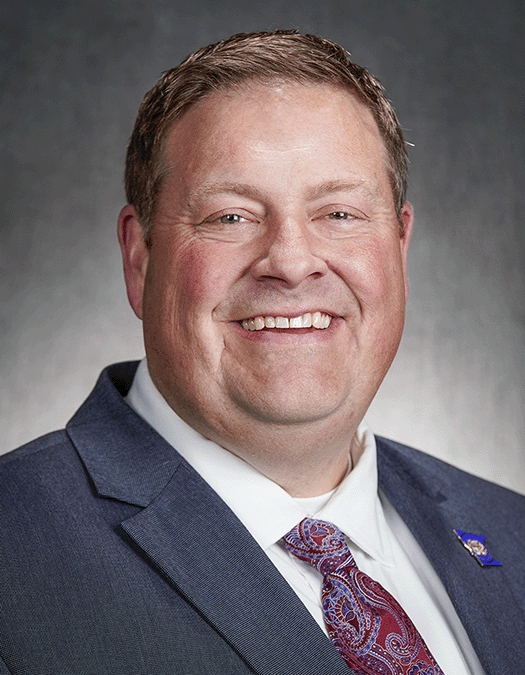
2025-2026 Regular Session Introduced by Keith Allen and 1 co-sponsor

The bill requires Minnesota budget forecasts to include quantified fraud risk, shaping revenue, expenditures, and costs with a formal framework and transparency.

Author added Allen
0
WeVote Research Nonpartisan
Bill Summary · HF 3683

Summary of HF 3683 (Minnesota, 2025-2026)

Purpose and intent

HF 3683 proposes that the state budget forecast process explicitly includes the potential impacts of fraud—both in terms of likelihood and financial consequences. The bill aims to improve the accuracy and reliability of budget projections by accounting for fraudulent activity as a risk factor that can affect revenues, expenditures, and overall fiscal condition.

Key provisions and changes

  • Forecast inclusions: Mandates that state budget forecasts incorporate quantified considerations of fraud risk. This includes assessing how fraud could influence:
    • Revenue collections (e.g., tax or fee instruments),
    • Expenditures (e.g., misappropriation, improper payments, or program costs tied to fraud),
    • Administrative and enforcement costs associated with detecting and preventing fraud.
  • Risk assessment framework: Requires the development or adoption of a structured framework for evaluating fraud risk within the forecast, potentially including:
    • Probability assessments of fraud incidents,
    • Potential financial impact under different scenarios,
    • Sensitivity analyses to illustrate how fraud variability could alter fiscal outlooks.
  • Data and methodology: Encourages or directs use of best practices, data sources, and methodologies to estimate fraud-related impacts consistently across forecast documents.
  • Transparency and communication: Policy likely emphasizes clear disclosure in forecast reports about the assumptions related to fraud risk, the range of potential impacts, and the rationale behind chosen estimates.
  • Coordination: May require collaboration among relevant state agencies (e.g., Office of Management and Budget, Fiscal Forecasting divisions, and fraud prevention/controls units) to integrate fraud considerations into forecasts.

Who/what would be affected

  • State budget forecasting offices and staff: Responsible for integrating fraud risk into official forecast documents and accompanying analysis.
  • State agencies and departments: Entities that may be evaluated for fraud risk exposure as part of revenue, expenditure, and program integrity assessments.
  • Policy makers and the public: Receives forecast models that include fraud considerations, enhancing transparency about potential fiscal risks.
  • Auditing and controls units: Could be affected by a heightened emphasis on fraud risk in budgeting and financial planning processes.

Procedural and timeline aspects

  • Status: Introduced and read for the first time on February 25, 2026; referred to the State Government Finance and Policy committee. A co-sponsor is listed (Keith Allen; Jim Nash), with an additional author (Allen) added on March 5, 2026.
  • Next steps in the process: Depending on committee action, HF 3683 would move through standard legislative steps (hearings, potential amendments, floor votes in the House, and eventual consideration by the Senate). If enacted, the forecast applicability would begin according to the bill’s effective date or phased timeline as specified in the final version.

Additional notes

  • The bill’s emphasis is on enhancing fiscal forecasting realism by treating fraud risk as a calculable factor, potentially affecting budget reserves, contingency planning, and statutory budget balance considerations.
  • Specific dollar amounts, percentages, or exact methodologies are not provided in the available summary; the final bill text would detail the required framework, data sources, and implementation schedule.

Compiled from official sources — confirm details with the bill’s official record.

Sign in to ask a question.