

WeVote

Bill

Bill

HF 2190

Fillmore, Goodhue, Houston, Wabasha, and Winona Counties; funding provided to clean and reestablish earthen dams, and money appropriated.

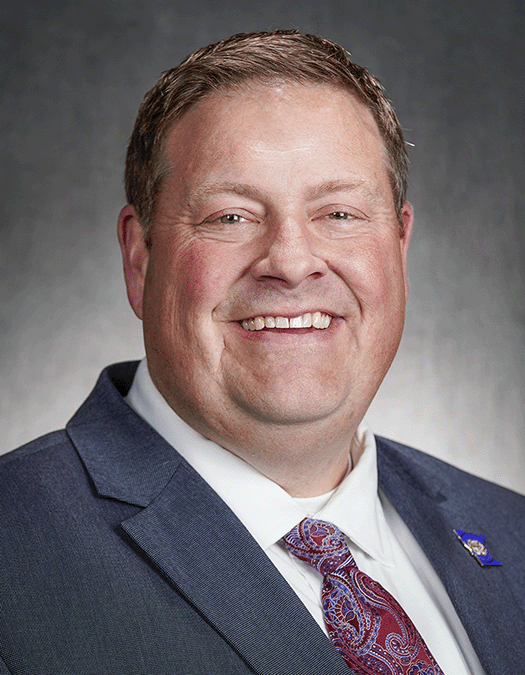
2025-2026 Regular Session Introduced by Keith Allen and 4 co-sponsors

The bill authorizes state funding to clean up and restore aging earthen dams in five southeastern Minnesota counties to improve dam safety and downstream risk management.

Introduction and first reading, referred to Legacy Finance
0
WeVote Research Nonpartisan
Bill Summary · HF 2190

Bill Summary: HF 2190 (2025-2026) – Minnesota

Basic information

  • Jurisdiction: Minnesota
  • Session: 2025-2026
  • Title/Focus: Funding to clean and reestablish earthen dams in Fillmore, Goodhue, Houston, Wabasha, and Winona Counties; including appropriation of funds.
  • Introduction/Referral: Introduced and referred to Legacy Finance on March 12, 2025.
  • Sponsors (co-sponsors): Pam Altendorf; Steve Jacob; Greg Davids; Keith Allen; Ripper Repinski.

Purpose and intent

HF 2190 authorizes state financial support to clean up and restore earthen dams located in the specified southeastern Minnesota counties: Fillmore, Goodhue, Houston, Wabasha, and Winona. The bill aims to address maintenance, safety, and functional restoration of aging dam infrastructure that may pose risks to downstream communities and ecosystems, while ensuring structural integrity and compliance with applicable standards.

Key provisions and changes

  • Funding authorization: The bill provides appropriations (specific dollar amounts are not included in the provided summary) to support:
    • Cleaning and maintenance of earthen dams
    • Reestablishment/restoration efforts to ensure dams meet current safety and performance requirements
  • Scope of projects: Projects would be limited to the earthen dam facilities within the five named counties.
  • Project objectives:
    • Improve dam safety and resilience against failure
    • Restore or maintain the intended water management, flood control, or ecological functions of the dams
    • Potentially address sediment buildup, seepage issues, spillway performance, and downstream risk mitigation
  • Administration and oversight: While not detailed in the summary, typical provisions would allocate supervising agencies (likely the Department of Natural Resources, Missouri Riverdam safety programs, or State Engineer’s office) to oversee construction, compliance, and accountability.

Who/what is affected

  • Geographic scope: Five counties in southeastern Minnesota (Fillmore, Goodhue, Houston, Wabasha, Winona).
  • Dam infrastructure: Earthen dams within the counties designated for cleaning, repair, and reconstruction.
  • Public safety and local communities: Downstream residents and landowners who benefit from improved dam safety and flood risk reduction.
  • Funding recipients: Local governments, dam owners, or project contractors responsible for executing cleanup and restoration work, funded by state appropriations.

Procedural and timeline aspects

  • Legislative stage: Introduced and referred to Legacy Finance (March 12, 2025). As a House bill, it will proceed through committee hearings (Legacy Finance and potentially others) before floor action.
  • Appropriations process: Any funding will be subject to the state budget process, including potential amendments, fiscal notes, and negotiation with other appropriations measures.
  • Implementation timeline (typical): If enacted, projects would move from planning and design to procurement and construction over multiple fiscal years, contingent on appropriation timing, permitting, and contractor availability.

Potential impacts and considerations

  • Safety improvements: Expected enhancement in dam safety and downstream risk management.
  • Local infrastructure and environment: Potential short-term disruptions during construction; long-term gains in water management and ecological stability.
  • Fiscal impact: Requires a state appropriation; the size of the funding and its distribution across the five counties will influence overall cost and timelines.

If you’d like, I can add a quick comparison to similar statewide dam safety funding bills or outline potential fiscal note considerations once the exact appropriated amounts are available.

Compiled from official sources — confirm details with the bill’s official record.

Sign in to ask a question.