

WeVote

Bill

Bill

E 1625

Establishes a plan setting forth an itemized list of grantees for a certain appropriation for the 2026-27 state fiscal year for grants in aid for certain services and expenses

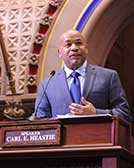
2025 Regular Session Introduced by Carl Heastie

Establishes a detailed, itemized plan to distribute 2026-27 appropriations to various grant programs, listing exact grantees and amounts or methods, subject to broad Assembly appro

ADOPTED
0
WeVote Research Nonpartisan
Bill Summary · E 1625

Overview

Bill E 1625 (Assembly) proposes establishing a detailed plan for distributing a specified 2026-27 appropriation across a broad set of grant programs. The aim is to itemize grantees and the amounts (or allocation method) for funds originally appropriated in prior years and reappropriated in 2026. The plan requires approval by the Speaker of the Assembly and the Director of the Budget and must be enacted through a majority vote of all Assembly members.

Main purpose and intent

  • Create an explicit, itemized plan for distributing 2026-27 funds allocated as aid to localities and related programs.
  • Cover multiple program areas, including health and mental health services, education, criminal justice, municipal services, parks, veterans’ services, older adults, and not-for-profit organizations.
  • Include specific grant awards and/or allocation methods for numerous grantees and entities, ensuring transparency in the distribution process.

Key provisions and changes

  • The bill references and amends several existing Assembly resolutions that establish prior stock schedules for grantees in various categories (health and mental health; criminal justice and municipal entities; aid to localities for municipalities and not-for-profits; public libraries and school districts; and Mitchell-Lama/public housing authorities).
  • For each category, it mandates that funds originally appropriated in a given year (2021, 2022, 2024, 2025, 2026, and related reappropriations) be apportioned via a plan that lists the exact grantees and amounts or the allocation methodology.
  • The plan must be added to a formal appropriation resolution and approved by a roll-call vote of all members elected to the Assembly.
  • The bill enumerates extensive schedules of grantees and amounts across numerous categories, including but not limited to:
    • Health and mental health programs and providers
    • Criminal justice organizations and municipal entities
    • Municipalities and community violence intervention services
    • Public parks, historical preservation, and recreational groups
    • Not-for-profit organizations and Edward Byrne Memorial Grants
    • Mitchell-Lama properties and properties owned by public housing authorities
  • The allocation process is designed to be dynamic, with revision possible by amending, removing, or adding to the schedules via the enacted resolutions.

Who would be affected

  • A wide array of entities: health and mental health providers, education-related organizations, criminal justice and municipal bodies, non-profit organizations, park and recreational groups, veterans’ and older adults programs, housing authorities, and Mitchell-Lama properties.
  • State agencies and officials responsible for budget approval: Speaker of the Assembly and the Director of the Budget.
  • Participating municipalities, school districts, libraries, and housing-related properties listed in the schedules.

Procedural and timeline aspects

  • Requires creation and approval of a detailed itemized plan for each relevant appropriation category.
  • The plan must be incorporated into a resolution calling for expenditure, with a roll-call vote by all members elected to the Assembly.
  • The bill references schedules added to multiple prior Assembly resolutions (E820 of 2025, E446 of 2021, E1075 of 2022, E2449 of 2024, etc.), indicating a comprehensive aggregation of several years’ allocations.
  • Action history shows passage through committee and floor (referred to Ways and Means, then Rules and Calendar actions) in June 2026, with sponsor attribution to Carl Heastie.

Note: This summary focuses on the substantive structure and potential impact of the bill based on the provided text.

Compiled from official sources — confirm details with the bill’s official record.

Sign in to ask a question.