

WeVote

Bill

Bill

HF 72

Entities or organizations that receive state funding prohibited from making campaign expenditures or otherwise expending money for any political purpose.

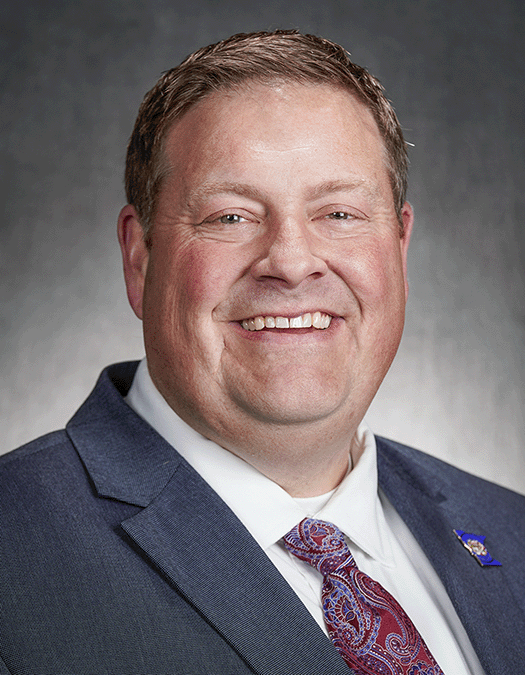
2025-2026 Regular Session Introduced by Keith Allen and 10 co-sponsors

The bill bars any state-funded entity from spending funds on political campaigns or political purposes.

Referred to Elections
0
WeVote Research Nonpartisan
Bill Summary · HF 72

Summary of HF 72 (2025-2026 Session | Minnesota)

Purpose and Intent

HF 72 prohibits entities or organizations that receive state funding from engaging in campaign expenditures or spending money for any political purpose. The bill targets the use of public funds or funds from state-supported sources by organizations in political campaigns, aiming to separate government funding from political activity.

Key Provisions and Changes

  • Prohibition on political expenditures by state-funded entities: Any entity or organization that receives state funding would be barred from making campaign expenditures or spending money for any political purpose.
  • Scope of “state funding”: The bill applies to organizations that receive state funds, though specifics on what constitutes “state funding” (grants, contracts, subsidies, appropriations, etc.) are not detailed in the provided overview. The underlying policy text would define the coverage to ensure all applicable funding streams are included.
  • Definition of political expenditures: The measure would prohibit using funds for campaign purposes, which may include activities such as contributions to campaigns, political action committee (PAC) support, advertising supporting/opposing candidates or ballot measures, and other politically targeted spending.
  • Compliance and enforcement: The bill would establish requirements for entities to comply with the prohibition, potentially including recordkeeping, reporting, or certification aspects to verify adherence. Penalties or remedies for violations would typically be outlined, such as civil penalties, loss of funding, or other enforcement mechanisms.
  • Effective date and transition: The bill would specify when the prohibitions take effect (e.g., upon enactment, or a delayed effective date) and whether existing obligations must be reconciled within a grace period.

Who Would Be Affected

  • State-funded organizations: Nonprofits, educational institutions, research centers, community organizations, or other entities that receive state funding would be directly affected.
  • Campaigns and political activities: Organizations that might otherwise use state funds to influence elections or public policy would be constrained.
  • State agencies and funders: Agencies distributing funds would need to monitor compliance and implement any reporting or certification requirements.

Procedural and Timeline Aspects

  • Introduction and referrals: HF 72 was introduced and referred to the Elections committee.
  • Amendments and floor actions: The bill underwent amendments in late February 2025 and advanced through the House, including a third reading as amended and passage of the amended version.
  • Sponsor and co-sponsors: Primary sponsor(s) with a broad slate of co-sponsors, including Cal Warwas, Pam Altendorf, Harry Niska, Keith Allen, Jimmy Gordon, Zach Duckworth, John Burkel, Krista Knudsen, Erica Schwartz, Elliott Engen, and Ben Davis.
  • Status (as of provided history): The House successfully passed the bill as amended by late February 2025 and proceeded to further proceedings (introduction/first reading occurred March 3, 2025 with referral to Elections).

Additional Notes

  • The summary reflects the substantive aim: preventing state-funded entities from allocating funds to political campaigns or political purposes.
  • Exact definitions (what counts as “state funding” and what constitutes a “political purpose/expenditure”), specific enforcement mechanisms, penalties, reporting requirements, and any exceptions would be found in the bill’s text. For a complete understanding, review the enacted language, committee minutes, and fiscal notes.

If you’d like, I can pull in the precise statutory definitions, enforcement provisions, and any fiscal impact estimates once you provide or confirm access to the full bill text.

Compiled from official sources — confirm details with the bill’s official record.

Sign in to ask a question.