

WeVote

Bill

Bill

HF 2380

Disability accommodations included as protection from discrimination.

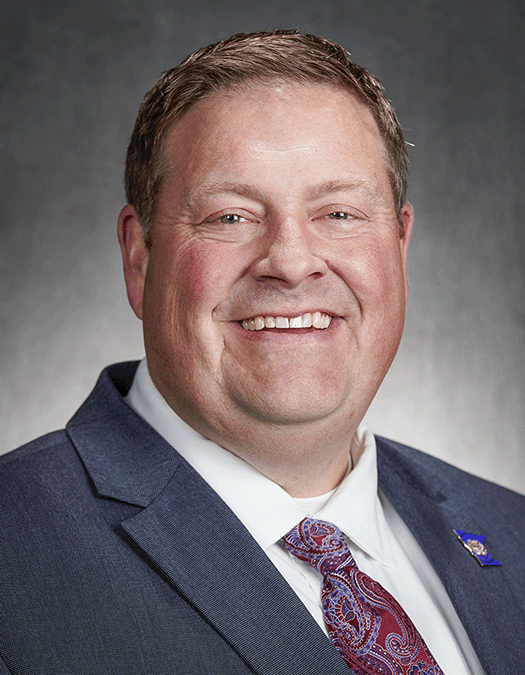
2025-2026 Regular Session Introduced by Keith Allen and 24 co-sponsors

Disability accommodations become a protected element to prevent discrimination in employment, housing, public services, education, and public accommodations, with an interactive pr

Author stricken Davids
0
WeVote Research Nonpartisan
Bill Summary · HF 2380

Summary of HF 2380 (2025-2026) — Disability Accommodations Included as Protection from Discrimination

Purpose and intent

HF 2380 aims to amend Minnesota’s human rights laws to explicitly include disability accommodations as a protection against discrimination. The bill places disability accommodations within the broader framework of the state’s anti-discrimination statutes, clarifying that accommodations for individuals with disabilities are essential to ensuring equal participation in employment, housing, public accommodations, public services, and education. The overarching principle is that accommodations enable full participation, and failing to engage in the accommodation process can itself be discriminatory.

Key provisions and changes

  • Scope of discrimination protections (Minnesota Statutes 2024, § 363A.02, subd. 1, amended):

    • The bill preserves the existing protected characteristics in five major domains:
    • Employment
    • Housing and real property
    • Public accommodations
    • Public services
    • Education
    • For each domain, disability accommodation is integrated as part of the protected status framework. The exact wording in the bill adds and emphasizes disability-related accommodations as necessary to prevent discrimination and to promote equal access.
  • Accommodations as a protection (Section 1, subsection c):

    • The bill states that accommodations allow people with disabilities to participate fully in all areas of protection listed above.
    • It clarifies that failure to engage in the process to determine an accommodation may be discriminatory. In other words, organizations and entities covered by the statute have an obligation to engage in an interactive process or equivalent steps to determine appropriate accommodations, and neglecting this process could violate the law.
  • Non-retroactivity and public policy context:

    • The bill reiterates the public policy goal of protecting individuals from unfounded discrimination while supporting positive action programs to combat discrimination. The emphasis on accommodations does not appear to limit other protections; rather, it expands the practical application of discrimination protections to explicitly include disability accommodations.

Who would be affected

  • Individuals with disabilities: Direct beneficiaries through enhanced protection and clearer access to required accommodations in employment, housing, public accommodations, public services, and education.
  • Employers, housing providers, public service entities, schools/universities, and public accommodations: Entities subject to Minnesota’s anti-discrimination laws would have an explicit obligation to provide reasonable accommodations and engage in the accommodation process when interacting with individuals with disabilities.
  • State and local governments: As enforcers and implementers of human rights laws, they would need to ensure policies and procedures accommodate disabilities and meet the interactive process requirements.

Procedural and timeline aspects

  • Status and process:

    • Introduced and referred to the Judiciary Finance and Civil Law committee.
    • The bill has undergone amendments through multiple rounds of sponsorship changes and committee actions.
    • As of the latest action, it has been adopted as amended and placed on the General Register.
    • The action history shows ongoing consideration during the 2025-2026 session, with formal readings and committee reports contributing to potential passage.
  • Enforcement and remedies:

    • While specific procedural remedies are not detailed in the provided text, the bill’s alignment with existing anti-discrimination law implies standard enforcement mechanisms (complaints to the Minnesota Department of Human Rights, civil actions, remedies for discriminatory practices) would apply, with added emphasis on the accommodation process.

Notes for readers

  • The bill expands the concept of discrimination protection to explicitly foreground disability accommodations, signaling a proactive stance on ensuring access and participation.
  • The exact definitions of “accommodations” and the procedural requirements (e.g., timelines for responses, what constitutes a reasonable accommodation, processes for disputes) would be further clarified in the statutory language and any accompanying administrative rules or guidance if enacted.
  • For stakeholders, key implementation considerations include establishing interactive processes, training staff, and updating policies to reflect the obligation to provide and engage in accommodations for individuals with disabilities.

If you want, I can pull out the precise statutory language references and compare this bill to the current law or to the related SF3210 (as referenced in the action history) to highlight any nuanced differences.

Compiled from official sources — confirm details with the bill’s official record.

Sign in to ask a question.