

WeVote

Bill

Bill

HF 1399

Commissioner of corrections required to maintain a supply of opiate antagonists to administer to persons who overdose in correctional facilities, and commissioner required to provide training to employees on how to administer opiate antagonists.

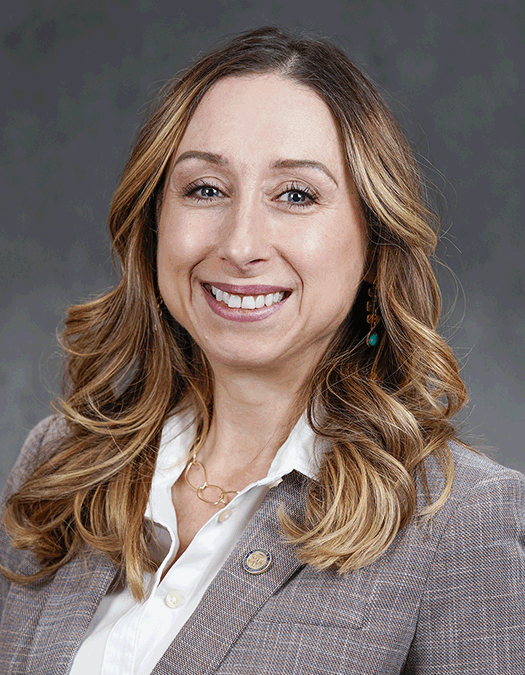
2025-2026 Regular Session Introduced by Kaela Berg and 4 co-sponsors

HF 1399 requires the Minnesota Department of Corrections to stock naloxone in correctional facilities and train staff to administer it during overdoses to save lives.

Authors added Curran, Berg, and Johnson, P.
0
WeVote Research Nonpartisan
Bill Summary · HF 1399

HF 1399 — Summary

Overview

HF 1399 would require the Minnesota Department of Corrections to maintain a supply of opiate antagonists (e.g., naloxone) to administer to persons who overdose in correctional facilities and to provide training to employees on how to administer these antagonists. The bill focuses on improving overdose response within custody settings.

What the bill would do

  • Mandate the Commissioner of Corrections to maintain an adequate stock of opiate antagonists for use in correctional facilities when overdoses occur.
  • Require the Commissioner to provide training to correctional facility employees on how to administer opiate antagonists.

Key provisions (as introduced)

  • Stocking requirement: The department must keep a supply of opiate antagonists available on-site to respond to overdoses in facilities.
  • Training obligation: Correctional staff must receive training on the administration of opiate antagonists, covering proper procedures and applicable safety considerations.

Note: The bill text in the provided materials does not specify exact stock levels, dosing guidelines, training curricula, or funding mechanisms. Those details would typically appear in the formal bill language or accompanying fiscal notes if available.

Who would be affected

  • Minnesota Department of Corrections (DOC): Responsible for stocking opiate antagonists and delivering required training.
  • Correctional facility staff and medical personnel: Surface recipients of the training and authorized to administer the antagonists.
  • Inmates and individuals within correctional facilities: Benefit from improved overdose response within custody settings.

Timeline and status (as of provided actions)

  • Introduced: February 24, 2025
  • Legislative actions:
    • February 24, 2025: Introduced and first reading; referred to Public Safety Finance and Policy
    • February 26, 2025: Author added Virnig
    • March 5, 2025: Authors updated to include Curran, Berg, and Johnson, P.
  • Related legislation: Companion bill SF 2837 (Senate)

Fiscal and implementation considerations

  • Potential costs: Stocking naloxone (or similar agents) and providing ongoing training may entail ongoing procurement and training expenses for the DOC.
  • Implementation logistics: Determining appropriate stock levels, placement within facilities, and the scope of training (e.g., who must be trained, training frequency) will affect timelines and budget.
  • Oversight and evaluation: Possible need for reporting on overdose incidents and training completion rates, to evaluate effectiveness.

Relationship to companion bill

  • SF 2837 serves as the Senate companion to HF 1399. Tracking both bills can provide a fuller view of the legislative approach and potential amendments across chambers.

Why this matters

This bill seeks to enhance life-saving responses to overdoses occurring within correctional facilities by ensuring rapid access to antidotes and knowledgeable staff, potentially reducing overdose fatalities and improving health outcomes for incarcerated individuals.

Compiled from official sources — confirm details with the bill’s official record.

Sign in to ask a question.