

WeVote

Bill

Bill

HF 4608

Certain disclosures and implementation of a corequisite model related to developmental courses required, and report required.

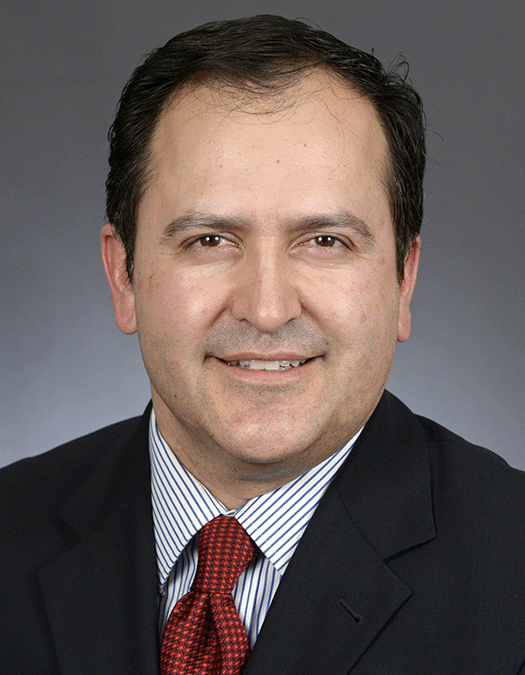
2025-2026 Regular Session Introduced by Jon Koznick

Requires disclosures for developmental courses, implements corequisite supports within college courses, and mandates a reporting on implementation and outcomes.

Introduction and first reading, referred to Higher Education Finance and Policy
0
WeVote Research Nonpartisan
Bill Summary · HF 4608

Summary of HF 4608 (2025-2026) – Minnesota

Overview

HF 4608 is a Minnesota bill dealing with disclosures and the implementation of a corequisite model for developmental education courses, including reporting requirements. The bill aims to clarify disclosure obligations related to developmental coursework and outline implementation steps for a corequisite model in place of traditional prerequisite coursework, along with a mandated report.

Purpose and Intent

  • To promote transparency around developmental education by requiring specific disclosures to students.
  • To facilitate a transition to a corequisite model for developmental courses, whereby students receive developmental support within the college-level course (rather than taking stand-alone prerequisite courses).
  • To establish reporting requirements to monitor implementation progress, outcomes, and compliance.

Key Provisions (as described by the bill title and action history)

  1. Disclosures for Developmental Courses

    • Requires particular information to be disclosed to students enrolling in developmental courses.
    • Likely focuses on expectations, outcomes, success metrics, and available supports, though the exact disclosure items are not enumerated in the provided summary.
  2. Corequisite Model Implementation

    • Requires implementation of a corequisite model for developmental education.
    • A corequisite model typically places students directly into college-level courses while providing integrated developmental supports (such as tutoring, labs, or tutoring services) within or alongside the course.
    • The bill may outline timing, pilot periods, or phased adoption, and may set standards for how colleges design and deliver corequisite supports.
  3. Reporting Requirement

    • Mandates a report related to the implementation and outcomes of the corequisite model.
    • Likely to include metrics such as completion rates, course pass rates, progression to subsequent coursework, remediation costs, and student success indicators.
    • The report may be due by a specified date and could be targeted to a state education or higher education policy committee.
  4. Scope and Applicability

    • The bill appears to apply to higher education settings within Minnesota, focusing on developmental education within college or university programs.
    • The corequisite model is intended as an alternative to traditional developmental sequences.

Who Would Be Affected

  • Students: Those enrolling in developmental education courses, who would receive disclosures and potentially participate in corequisite-supported courses.
  • Colleges and Universities: Institutions implementing the corequisite model and producing required disclosures and the mandated report.
  • Administrative and Academic Offices: Offices responsible for student advising, course design, accessibility of supports, compliance, and reporting.

Procedural and Timeline Aspects

  • Status: Introduced and read once on March 23, 2026, and referred to the Higher Education Finance and Policy committee.
  • Sponsor: Jon Koznick (co-sponsor).
  • As introduced, the bill outlines intent and requirements but does not specify exact implementation deadlines or report submission dates in the provided summary. Those details would typically be clarified in committee amendments or the bill’s final version.

Potential Impacts and Considerations

  • If enacted, higher education institutions may need to revise catalog language to include disclosures and redesign developmental coursework to integrate corequisite supports.
  • The reporting requirement could generate data to inform policy decisions on remediation and student success.
  • The transition to a corequisite model may affect student time-to-degree, remediation costs, and overall articulation of developmental education across Minnesota colleges.

If you’d like, I can tailor this summary to include hypothetical language typically found in such bills (e.g., sample disclosures, corequisite design features) or add a comparison to Minnesota’s existing developmental education frameworks.

Compiled from official sources — confirm details with the bill’s official record.

Sign in to ask a question.