

WeVote

Bill

Bill

HF 679

Award amounts of innovative service-learning grants increased, and money appropriated.

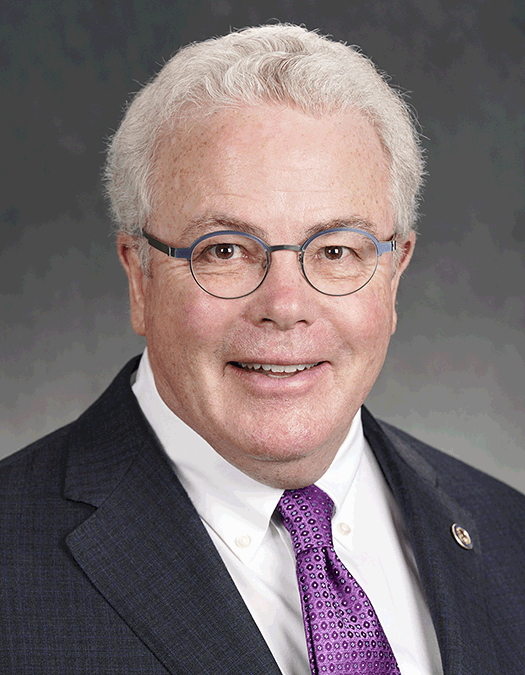
2025-2026 Regular Session Introduced by Ned Carroll and 7 co-sponsors

HF 679 expands and funds innovative K-12 service-learning grants, increasing the cap to $75,000, requiring meaningful student-led partnerships, and ongoing outcome reporting with $

Author added Keeler
0
WeVote Research Nonpartisan
Bill Summary · HF 679

Summary of HF 679 (2025-2026) – Minnesota

Purpose and intent

HF 679 seeks to expand and increase funding for innovative service-learning grants in Minnesota’s K-12 system. The bill updates definitions, strengthens requirements for service-learning partnerships, raises grant amounts, and establishes ongoing reporting and appropriation provisions. The overarching goals are to enhance student engagement, improve academic achievement, close achievement gaps, advance civic readiness, and support community-facing service-learning activities integrated into school curricula.

Key provisions and changes

Section 1: Innovation service-learning grants (amendment to Laws 2023, ch. 55, art. 2, sec. 59)

  • Definitions and eligibility
    • Clarifies terms:
    • “Eligible school” includes traditional districts, charter schools, Tribal schools, and qualifying cooperatives.
    • “Eligible service-learning partnership” includes at least one eligible school and one community partner (e.g., community-based orgs, agencies, or subdivision) and may involve additional partners (e.g., postsecondary institutions, parents, businesses, media).
  • Establishment and requirements (Subd. 2)
    • Creates a technical assistance and grant program to initiate/expand innovative service-learning for K-12 students.
    • Requires a student-adult partnership design, with at least one adult partner involved before grant submission.
    • The fiscal agent for the grant must be a participating eligible school or member organization.
    • Partnerships must include at least two students and two school employees, plus a community partner, and must guide students to:
    • Actively participate in service-learning addressing needs.
    • Collaborate effectively with partners.
    • Align activities with state or local standards (including local CTE standards).
    • Apply knowledge to community problems, foster civic engagement, and explore career pathways.
  • Grant application (Subd. 2, continued)
    • Applications to the Commissioner of Education must describe plans to:
    • Integrate student-designed/led service-learning into curricula.
    • Provide school-day service-learning with optional after-school components.
    • Align activities with standards and ESEA state plan requirements (or equivalents).
    • Prioritize service-learning as an educational keystone.
    • Include student-led experiences addressing community needs.
    • Identify required school and service-learning staff to support the partnership.
  • Innovation grants (Subd. 3)

    • Grant size: Up to $75,000 per grant (increased from the prior $50,000 cap).
    • Distribution: Grants must be equitably distributed across Minnesota by congressional district.
    • Categories may include startup or leader grants with differentiated maximums; leader grants may have additional requirements. Match requirement: Grantees must provide a 50% match (cash or in-kind) unless waived for applicants serving many students in families below federal poverty guidelines. Grant funds must be allocated per the approved application, with at least 50% of the grant amount passed to at least one community-based organization, community education program, state/federal agency, or political subdivision to help implement or defray direct costs.
    • Permissible use: Funds may be used for new service-learning initiatives or to maintain/expand existing ones.
  • Reporting (Subd. 4)

    • Grantees must report on educational/developmental outcomes for participating students and the school’s progress toward goals aligned with the state’s comprehensive achievement and academic readiness framework.
    • Grantees must report on community outcomes from service-learning activities.
    • The Commissioner must submit a biennial report to legislative committees with jurisdiction over K-12 education by February 15 of each odd-numbered year (note: date update from prior 2025 deadline).
  • Effective date

    • This section becomes effective July 1, 2025.

Section 2: Appropriation for innovative service-learning grants

  • General fund appropriation: Establishes funding for innovative service-learning grants.
    • 2026: $1,000,000
    • 2027: $1,000,000
  • Carryover: Any remaining balance from 2026 is available in 2027.
  • Effective date: July 1, 2025.

Who is affected

  • Eligible schools (districts, charter schools, Tribal schools, and qualifying cooperatives) and their staff.
  • Students in K–12, who participate in student-led, service-learning projects.
  • School personnel (teachers, administrators, service-learning coordinators, curriculum specialists, etc.) designated to develop and support service-learning partnerships.
  • Community partners (community-based organizations, education programs, state/federal agencies, political subdivisions, businesses, postsecondary entities, etc.) that collaborate on service-learning projects.
  • Communities and local organizations that benefit from service activities and partnerships.

Procedural and timeline notes

  • Effective date: July 1, 2025.
  • Appropriations timeline: New funding authorized for 2026 and 2027, with potential carryover from 2026.
  • Reporting: Biennial reporting requirement by February 15 of odd-numbered years, via the Commissioner to Legislature.
  • Grants distribution: Intent to distribute grants equitably by congressional district; potential differentiation between startup and leader grant categories.

Bottom line

HF 679 increases the grant amount cap from $50,000 to $75,000, expands eligibility and partnership requirements for innovative service-learning projects, mandates a 50% cost-match (with potential waivers), ensures meaningful student-led design, and strengthens accountability through outcomes reporting. The bill would allocate $1 million annually (starting 2026) from the general fund to support these grants, with ongoing reporting to legislators.

Compiled from official sources — confirm details with the bill’s official record.

Sign in to ask a question.