

WeVote

Bill

Bill

HF 82

Athletic trainer scope of practice clarified.

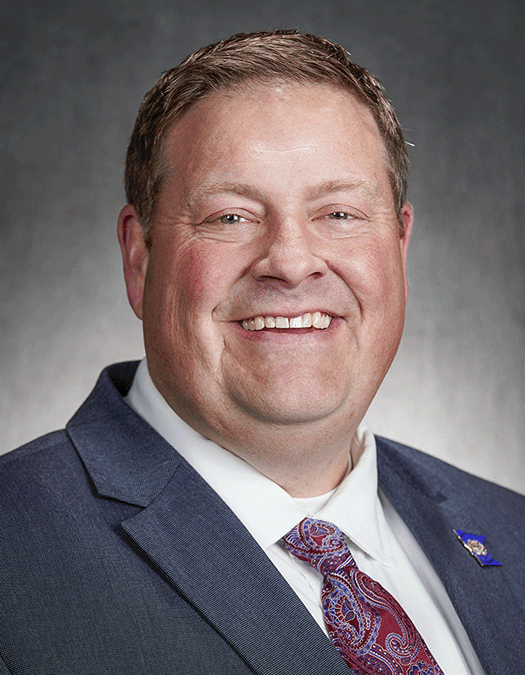
2025-2026 Regular Session Introduced by Keith Allen and 18 co-sponsors

HF 82 defines athletic training activities, requires physician-led protocols and supervision, sets clear practice boundaries, and prohibits unlicensed medical procedures.

Referred to Health and Human Services
0
WeVote Research Nonpartisan
Bill Summary · HF 82

Summary of HF 82 (2025-2026) – Minnesota: Athletic Trainer Scope of Practice Clarified

Purpose and intent

HF 82 aims to clarify and codify the scope of practice for athletic trainers in Minnesota. The bill defines athletic training and athletic trainer duties more explicitly, outlines supervision and collaboration requirements with licensed physicians, and sets boundaries on what athletic trainers may and may not do. It also revises related definitions and repeals older subdivisions to streamline regulatory language.

Key provisions and changes

  • Definition updates (Section 1 and Section 2)

    • Adds a new subdivision 6a defining “Athletic training” to include:
    • Risk reduction, wellness, and health literacy
    • Assessment, evaluation, and diagnosis
    • Critical incident management
    • Therapeutic intervention
    • Health care administration and professional responsibility
    • Reframes “Athletic trainer” to mean a person licensed under 148.7808 who practices athletic training per section 148.7806 and works within designated patient populations identified by the Board of Certification for the Athletic Trainer or its successor.
  • Scope of practice for athletic training (Section 3)

    • Athletic trainers must work under supervision/prescription of and in collaboration with a Minnesota-licensed primary physician in good standing.
    • Core activities include:
    • Prevention, recognition, and evaluation of athletic injuries
    • Emergency care and first aid
    • Management, treatment, rehabilitation of athletic injuries
    • May use therapeutic modalities (e.g., cold, heat, electrical, exercise, mechanical devices) consistent with training and the endorsed protocols.
    • Primary physician must establish evaluation and treatment protocols (recorded on a board-prescribed form) and update annually at license renewal.
    • At primary employment sites (excluding corporate settings), athletic trainers may evaluate and treat athletes for injuries not previously diagnosed for up to 30 days (or as designated by protocol). Preventative care beyond injury resolution is not considered treatment.
    • Athletic trainers can organize and administer athletic training programs, monitor athletes’ response to treatment, and suggest treatment plan modifications to the primary physician.
    • In clinical, corporate, and physical therapy settings, services conveyed as physical therapy must be performed under the direct supervision of a licensed physical therapist.
  • Limitations on practice (Section 4)

    • Athletic trainers cannot practice or claim to practice medicine, acupuncture, chiropractic, physical therapy (except as provided under 148.7806), podiatry, occupational therapy, or other licensed professions unless properly licensed for that profession.
    • If a patient’s condition is beyond the athletic trainer’s scope, the trainer must refer to an appropriate licensed professional (e.g., physician, chiropractor, PT, podiatrist, dentist) and follow established evaluation and treatment protocols.
    • Trainers must modify or terminate treatment if it is not beneficial or not tolerated by the patient.
  • Applicability and temporary practice (Section 5)

    • Provisions related to applicability remain, including a clause recognizing athletic trainers who are temporarily in Minnesota for an event and are licensed/certified by another state, or certified by the Board of Certification, for the event.
  • Repeal of older definitions (Appendix)

    • Repeals older definitions of “Athlete” and “Athletic injury” that existed in a prior set of statutes (subdivisions 4 and 5 of 148.7802).

Who is affected

  • Athletic Trainers in Minnesota
    • Those currently practicing athletic training under the Board of Certification framework and working in approved settings.
    • Must operate within the clarified scope, adhere to physician-approved protocols, and comply with supervision requirements.
  • Primary Care Physicians / Licensed Physicians
    • Responsible for establishing and maintaining evaluation/treatment protocols for athletic trainers in their employ or under their supervision.
  • Healthcare Settings
    • Clinic, school-based, and sports organizations employing athletic trainers, particularly regarding supervision structures, protocol development, and the delineation of practice boundaries.
  • Other Licensed Professions
    • The bill reinforces that athletic trainers must seek appropriate licensure if they intend to practice areas such as medicine, physical therapy (beyond current allowances), or other regulated fields.

Procedural and timeline aspects

  • The bill underwent first reading and referral in February 2025, with adoption of report and placement on the General Register as amended in March 2026.
  • It includes phases for:
    • Establishing and renewing physician-established protocols (to be updated annually at the athletic trainer’s license renewal).
    • Compliance with supervision requirements.
  • Repeals specific older subdivisions (4 and 5) of 148.7802 as part of modernization of definitions.

Notable details

  • The bill emphasizes that preventative care, health education, and reconditioning are not considered treatment once an injury has resolved.
  • It creates a framework for evaluating and treating athletes for up to 30 days (or as protocol allows) without a prior diagnosis, within the primary employment site (non-corporate settings).

Summary

HF 82 clarifies and modernizes Minnesota’s athletic trainer scope of practice by defining athletic training activities, mandating physician-led protocols, specifying supervision requirements, and setting clear boundaries against practicing beyond licensure. It also simplifies outdated definitions and ensures a pathway for temporary practice in specific events. The changes are designed to standardize care, improve patient safety, and delineate roles among athletic trainers, physicians, and other health professionals.

Compiled from official sources — confirm details with the bill’s official record.

Sign in to ask a question.