

WeVote

Bill

Bill

HF 4950

Tax on certain individuals and organizations convicted of and benefiting from fraud established.

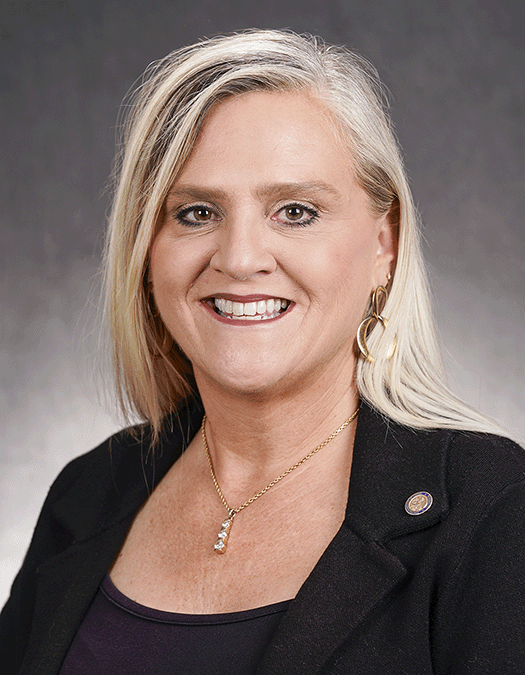
2025-2026 Regular Session Introduced by Pam Altendorf and 32 co-sponsors

Imposes a 100% tax on amounts obtained through fraud, with proceeds deposited into a Tax Relief Account for income and/or property tax relief.

Introduction and first reading, referred to Taxes
0
WeVote Research Nonpartisan
Bill Summary · HF 4950

Summary of HF 4950 (Session 2025-2026) – Minnesota

Purpose and Intent

HF 4950 proposes a new tax on amounts obtained through fraud. The bill creates a 100% tax on any amount obtained by fraud by individuals or organizations, including those who are convicted of fraud or determined by the commissioner to have engaged in fraud, as well as individuals or organizations that receive compensation in exchange for participating in fraudulent activity. The money collected under this tax would be directed to a dedicated tax relief account to support income and/or property tax relief.

Key Provisions

  • Tax Imposed (Section 295.90)

    • A tax equal to 100% of the amount obtained through fraud is imposed.
    • Applies in four scenarios:
    • Individuals or organizations convicted of fraud in state or federal court.
    • Individuals or organizations determined by the commissioner to have obtained money through fraud.
    • Individuals or organizations that receive compensation from a fraud-identified entity in exchange for participation in the fraudulent activity.
    • Individuals or organizations that receive compensation from a fraud-identified entity in exchange for participation in related fraudulent activity.
    • The tax applies regardless of any restitution or penalties already imposed or paid.
  • Role of the Commissioner (Section 295.90 Subd. 3)

    • The Commissioner of Revenue must investigate individuals/organizations reasonably believed to have engaged in fraud, in consultation with relevant law enforcement and other agencies.
    • The Commissioner must establish a payment schedule and enforcement mechanisms for the tax.
    • Appeals process for assessments under this section follows the procedures in Minnesota Statutes section 270C.35.
  • Deposit and Use of Revenue (Section 295.90 Subd. 4)

    • All money collected under this tax must be deposited into the Tax Relief Account.
    • Funds in the Tax Relief Account must be used solely for income tax relief, property tax relief, or both, as determined by law.
    • The account is established within the Special Revenue Fund.
  • Effective Date

    • Retroactive to fraud determinations made after December 31, 2019.

Who Would Be Affected

  • Individuals and organizations convicted of fraud in state or federal court.
  • Individuals and organizations deemed by the Commissioner of Revenue to have obtained money through fraud.
  • Individuals or organizations that receive compensation from someone engaged in fraud (either directly for participating in the fraudulent activity or for participating in related activities).

Procedural and Timeline Considerations

  • Investigation and Enforcement: The Commissioner is tasked with investigating suspected fraud cases in coordination with law enforcement and other agencies.
  • Tax Assessment and Appeals: The bill references a formal assessment process and aligns appeals with existing procedures (Minnesota Statutes § 270C.35).
  • Revenue Allocation: Revenue is earmarked for a dedicated Tax Relief Account within the Special Revenue Fund, with explicit用途 for income or property tax relief.
  • Retroactive Effect: Applies to fraud determinations made after December 31, 2019, meaning some past fraud determinations could be subject to the new tax.

Political/ Legislative Context

  • Introduced in the Minnesota House (HF 4950) during the 2025-2026 session.
  • Authored by a bipartisan group of representatives and include a wide slate of co-sponsors from multiple districts.

Potential Implications

  • Strong deterrent against fraudulent activity by imposing a full 100% tax on fraud-derived funds and related participation.
  • Creates a dedicated funding stream for tax relief programs, potentially offsetting some tax burdens for residents and businesses.
  • Could lead to increased enforcement activity by the Department of Revenue and collaboration with enforcement agencies.
  • The retroactive element could raise concerns about the scope of applying this tax to fraud determinations over the past several years; implementation would require careful compliance with due process and existing legal standards.

If you’d like, I can provide a side-by-side comparison with current Minnesota tax law or draft a one-page explainer for stakeholders.

Compiled from official sources — confirm details with the bill’s official record.

Sign in to ask a question.