

WeVote

Bill

Bill

HF 4037

Secretary of state required to provide voter and election data to an agency or department of the federal government.

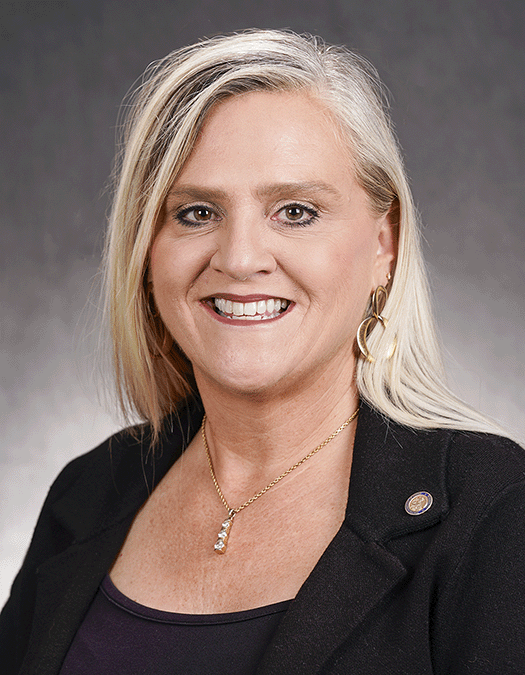
2025-2026 Regular Session Introduced by Pam Altendorf and 4 co-sponsors

Minnesota would be required to hand over to federal agencies any voter and election data it holds, overriding state privacy protections.

Introduction and first reading, referred to Elections Finance and Government Operations
0
WeVote Research Nonpartisan
Bill Summary · HF 4037

Summary of HF 4037 (2025-2026) – Minnesota

Bill Overview

  • Official Title (topic): An act relating to elections; requiring the secretary of state to provide voter and election data to an agency or department of the federal government.
  • Legislative session: 94th Legislature (2025-2026)
  • Bill number: HF4037
  • Introduced/Status: Introduced and referred to Elections, Finance, and Government Operations (as of 03/05/2026). Publicly posted 03/18/2026.
  • Principal sponsor: Noted co-sponsors: Pam Altendorf, Joe McDonald, Drew Roach, Jimmy Gordon, Ben Davis.

1) Purpose and Intent

  • To require the Minnesota Secretary of State to provide data related to voters and elections to an agency or department of the federal government upon request.
  • The bill expressly overrides state privacy or data laws (notwithstanding Minnesota laws such as chapter 13 or 201 or other laws) to facilitate data sharing with federal entities.

2) Key Provisions and Changes

Data Sharing Requirement

  • Mandatory data provision on request: The Secretary of State must provide to a federal agency or department any data that relates to voters and elections in Minnesota.
  • Scope of data: Upon a request, the Secretary must provide all data in the statewide voter registration system.
  • Timeline for provision: Data must be supplied no later than:
    • 180 calendar days after the request, or
    • the 90th day prior to the next regularly scheduled election,
    • whichever occurs sooner.
  • Interpretation of “voters”: Broadly defined to include:
    • Individuals who attempted to register but were not ultimately registered,
    • Individuals whose voter registration is not current,
    • Individuals who registered to vote but never voted.

Effect on Privacy/Data Protections

  • The bill explicitly states a carve-out from existing state data privacy laws (e.g., chapter 13 or 201 and other laws) to allow data sharing with federal agencies.

Effective Date

  • Effective date: The act becomes effective the day after final enactment.
  • Applies to data requests made on or after that date.

3) Who Would Be Affected

  • Secretary of State (Minnesota): Obligated to disclose voter and election data to a federal entity upon request, subject to the timeframes above.
  • Federal government agencies/Departments: Authorized recipient of Minnesota voter/election data under this act.
  • Individuals whose data may be shared: Broad group including registered voters, non-registered individuals who attempted registration, non-current registrations, and those who registered but did not vote.

4) Procedural and Timeline Aspects

  • Request timing: Data must be provided within the earlier of 180 days after the request or 90 days before the next regularly scheduled election.
  • Privacy implications: Substantial reduction or override of state-level privacy and data protection laws to enable federal data access.
  • Legal status: Introduced and currently in committee review (as of the latest action in March 2026).

5) Potential Implications and Considerations

  • Transparency vs. privacy: The bill prioritizes federally accessible voter/election data, potentially increasing concerns about privacy protections and state control over data.
  • Impact on voters: The broader definition of “voters” means more categories of individuals could have their data shared with federal entities.
  • Election security and governance: Supporters may argue for improved federal data capabilities for national election administration; critics may raise concerns about data misuse, civil liberties, and state sovereignty.

If you’d like, I can add a brief comparison to current Minnesota data-sharing practices or provide a one-page briefing for a legislative audience.

Compiled from official sources — confirm details with the bill’s official record.

Sign in to ask a question.