

WeVote

Bill

Bill

HF 2814

Requirements for state employees to report fraud strengthened.

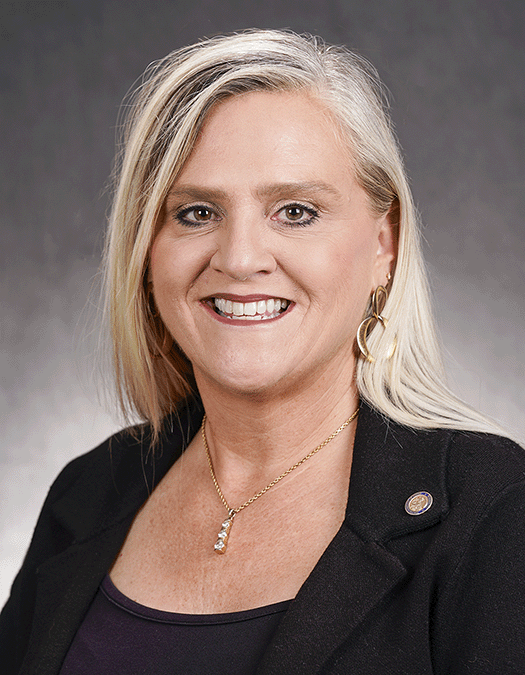
2025-2026 Regular Session Introduced by Pam Altendorf and 1 co-sponsor

Strengthens state employee duties to report suspected fraud, waste, or abuse with clearer channels, protections for reporters, and required investigations and records.

Introduction and first reading, referred to State Government Finance and Policy
0
WeVote Research Nonpartisan
Bill Summary · HF 2814

Summary of HF 2814 (2025-2026) – Minnesota

Purpose and intent

HF 2814 strengthens requirements for state employees to report fraud. The bill modifies and potentially expands existing fraud reporting obligations, aiming to improve detection, transparency, and accountability regarding fraud within state government operations.

Key provisions and changes (highlights)

  • Enhanced reporting obligation for state employees: The bill imposes or broadens duties for state employees to report suspected fraud, waste, or abuse in state agencies, departments, or programs.
  • Scope of reportable conduct: Provisions specify what constitutes reportable fraud-related activity (e.g., financial misconduct, misuse of state resources, falsification of records). The precise language may detail thresholds or types of fraud to be reported.
  • Reporting channels and procedures: Establishes or clarifies the approved channels for reporting (internal supervisors, ethics/compliance offices, or independent watchdogs) and the required methods (written or electronic reports). It may also outline confidentiality protections for whistleblowers.
  • Protection for reporters: Includes protections to shield individuals who report in good faith from retaliation, discipline, or adverse actions, and may specify processes for addressing retaliation claims.
  • Agency response and investigation: Requires timely acknowledgment and investigation of reported fraud, with timelines for initial response and completion, and possible cooperation requirements for agencies.
  • Records and accountability: May require agencies to maintain records of fraud reports and outcomes, and to report aggregate data on fraud investigations to a designated oversight body or the legislature.
  • Training and awareness: Potentially mandates training for state employees on recognizing and reporting fraud, and on the proper channels for doing so.
  • Penalties or enforcement: If applicable, the bill could specify penalties for non-compliance with the reporting requirements or outline consequences for mishandling reports (in a way that reinforces compliance rather than criminalizes ordinary whistleblowing).

Who is affected

  • State employees and contractors: Individuals employed by Minnesota state government, and possibly contractors under state contracts, who would be subject to the updated reporting duties.
  • State agencies and offices: Departments responsible for handling fraud reports, investigations, and protections for reporters.
  • Oversight and compliance bodies: Entities tasked with receiving reports, conducting investigations, ensuring confidentiality, and reporting to the legislature.

Procedural and timeline aspects

  • Author and referrals: Introduced and referred to the Committee on State Government Finance and Policy, likely progressing through standard legislative process with hearings, potential amendments, and votes.
  • Sponsors: Co-sponsors include Pam Altendorf and Patti Anderson, indicating bipartisan participation in the bill’s development.
  • Effective date and implementation: The bill would specify an effective date (e.g., upon enactment or a staged implementation) and may outline transition provisions for current reporting systems and training programs.

Practical implications

  • Strengthened reporting requirements could lead to increased detection of fraud and greater accountability in state operations.
  • Enhanced whistleblower protections may encourage more employees to come forward with credible concerns.
  • Agencies would incur costs related to training, process updates, and handling of reports, which could be offset by potential savings from reduced misconduct and improved efficiency.

If you’d like, I can tailor this summary to reflect the bill’s exact statutory language once available (e.g., definitional sections, specific reporting timelines, and any numerical thresholds).

Compiled from official sources — confirm details with the bill’s official record.

Sign in to ask a question.