

WeVote

Bill

Bill

HF 3724

Political subdivisions prohibited from establishing or enforcing ranked-choice voting.

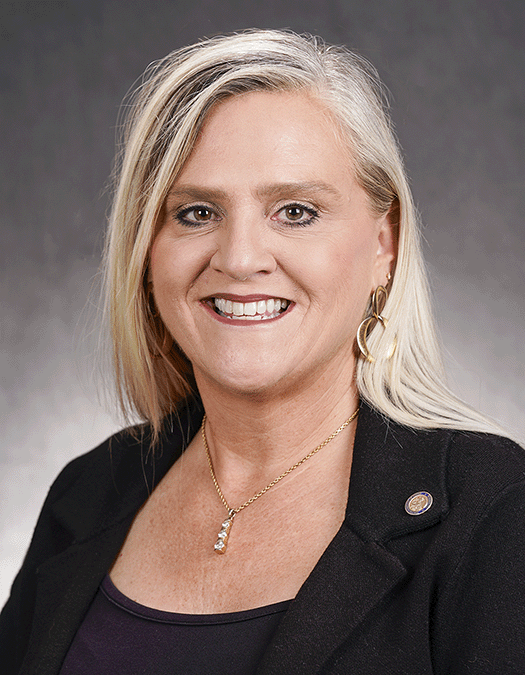
2025-2026 Regular Session Introduced by Pam Altendorf and 5 co-sponsors

The bill would prohibit all Minnesota local governments from establishing or enforcing ranked-choice voting for their elections.

Author added Lawrence
0
WeVote Research Nonpartisan
Bill Summary · HF 3724

Summary of HF 3724 (Minnesota, 2025-2026)

Purpose and Intent

HF 3724 proposes prohibiting political subdivisions in Minnesota from establishing or enforcing ranked-choice voting (RCV). The bill aims to restrict the use of RCV at local government levels, preventing cities, counties, school districts, or other political subdivisions from adopting or applying RCV systems for their elections.

Key Provisions and Changes

  • Prohibition on RCV by political subdivisions: The core provision bars any political subdivision within Minnesota from establishing, maintaining, or enforcing a ranked-choice voting system for elections.
  • Scope of prohibition: The bill targets political subdivisions broadly; it would apply to any local unit of government that administers elections, as opposed to statewide elections (which are not the focus of this bill).
  • Enforcement and compliance expectations: While not specified in the provided summary, typical language in similar bills would require local entities to conform to traditional plurality or other non-RCV voting methods already in use, and to change procedures accordingly if they have previously implemented RCV.
  • Definitions: The bill would define “ranked-choice voting” and distinguish it from other voting methods to ensure clear applicability and avoid ambiguity in enforcement.

Who Would Be Affected

  • Local government entities: Cities, counties, school districts, and other political subdivisions that administer elections and have adopted or considered ranked-choice voting would be directly affected.
  • Election officials and administrators: County and city election offices responsible for implementing or maintaining RCV systems would need to revert to non-RCV processes where applicable.
  • Voters in affected jurisdictions: Voter experience and ballot design could be impacted in jurisdictions that had adopted RCV, as they would return to alternative methods (e.g., plurality/majority methods).

Procedural and Timeline Aspects

  • Status: Introduced and referred to the Committee on Elections, Finance, and Government Operations (as of the initial readings).
  • Action history:
    • 2026-02-25: Introduction and first reading; referred to Elections, Finance and Government Operations.
    • 2026-02-26: Author added (Lawrence).
  • Sponsor Information:
    • Primary authorship: Representative (author not specified in the provided excerpt).
    • Co-sponsors: Pam Altendorf, Joe McDonald, Drew Roach, Jimmy Gordon, Bryan Lawrence, Ben Davis.
  • Next steps in legislative process: The bill would move through committee hearings, potential amendments, and votes in both chambers (House and Senate) before any passage. If passed, it would require enactment of any necessary conforming amendments and potential gubernatorial action.

Practical Implications

  • Policy implications: The bill reinforces a uniform approach to election administration at the local level by eliminating the ability of subdivisions to implement or maintain ranked-choice voting.
  • Election administration: Jurisdictions currently using RCV would need to transition to their prior voting method, including ballot design, tabulation procedures, and voter education related to the non-RCV method.
  • Legal and constitutional considerations: Depending on existing local charters, state law, and any prior local measures, there may be legal questions about the process and timelines required for a transition away from RCV. The bill would provide a state-level directive to prevent RCV adoption at the local level.

If you’d like, I can tailor this summary to emphasize potential impacts for a specific Minnesota county or city, or compare HF 3724’s approach to similar prohibitions in other states.

Compiled from official sources — confirm details with the bill’s official record.

Sign in to ask a question.