

WeVote

Bill

Bill

HF 637

Election judge employment status clarified.

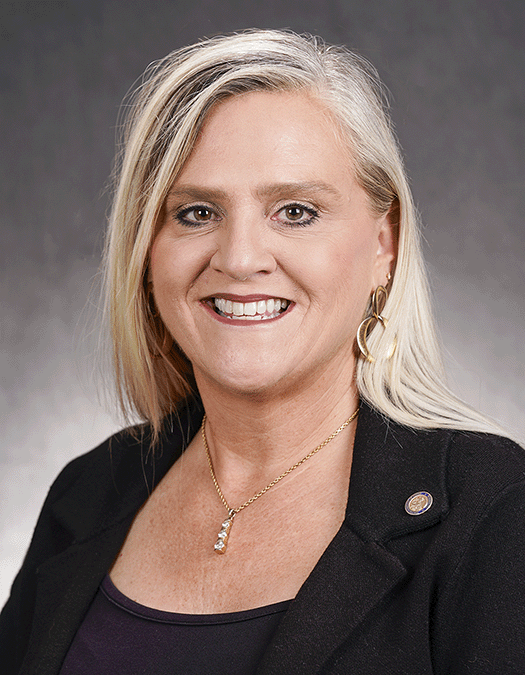
2025-2026 Regular Session Introduced by Pam Altendorf and 4 co-sponsors

Election judges are explicitly not employees of the appointing authority, and cannot be subject to unrelated employment requirements as a condition of their appointment.

Introduction and first reading, referred to Elections Finance and Government Operations
0
WeVote Research Nonpartisan
Bill Summary · HF 637

Summary of HF 637 (Minnesota, 2025-2026 Session)

Title

Election judge employment status clarified.

Purpose and Intent

HF 637 seeks to clarify that election judges are not employees of the appointing authority that designates them to serve in an election. The bill aims to prevent certain employment-relationship requirements from being imposed on election judges as a condition of appointment, particularly those unrelated to the judge’s duties or typical of permanent employment with the appointing authority.

Key Provisions

  • Amends Minnesota Statutes 2024, section 204B.19 by adding a new subdivision (Subdivision 7, “Employment status of election judges”).
  • Core reform: Explicitly states that nothing in section 204B.19 establishes that an election judge is an employee of the appointing authority.
  • Prohibition on conditions of appointment: An appointing authority may not require an individual who is appointed as an election judge to be subject to employment-related requirements that are unrelated to the ability to perform election judge duties or that would otherwise be required as a condition of employment for a permanent employee of the appointing authority.

Who/What Is Affected

  • Appointing authorities that designate election judges for polling places or other election-related roles.
  • Individuals serving as election judges, ensuring they maintain a status distinct from regular employee status with the appointing authority.
  • Election administration processes that rely on appointed election judges.

Procedural and Timeline Aspects

  • Introduction date: February 12, 2025.
  • First reading and referral: February 13, 2025, to Elections Finance and Government Operations committee.
  • Status: Bill introduced and under committee consideration; co-sponsors listed (Pam Altendorf, Joe McDonald, Duane Quam, Jimmy Gordon, Ben Davis).

Potential Impact

  • Clarifies employment relationship for election judges, potentially reducing the likelihood of misclassification as permanent employees.
  • May limit the scope of employment-related requirements that appointing authorities can impose on election judges as a condition of appointment.
  • Aims to protect the non-employee status of election judges, preserving their independence and focus on performing election duties rather than ongoing employment obligations.

Notes

  • The bill is focused on the statutory interpretation of the status of election judges rather than creating compensation changes or broad staffing reforms.
  • The language emphasizes that appointment criteria should relate to the ability to perform duties and not to unrelated employment conditions.

If you’d like, I can add a plain-language example of how this might affect a hypothetical election judge appointment scenario or track updates as the bill progresses through committee stages.

Compiled from official sources — confirm details with the bill’s official record.

Sign in to ask a question.