

WeVote

Bill

Bill

HF 2367

Community first services and supports reimbursement rates modified, consumer-direct community supports budgets increased, Minnesota Caregiver Defined Contribution Retirement Fund Trust established, and money appropriated.

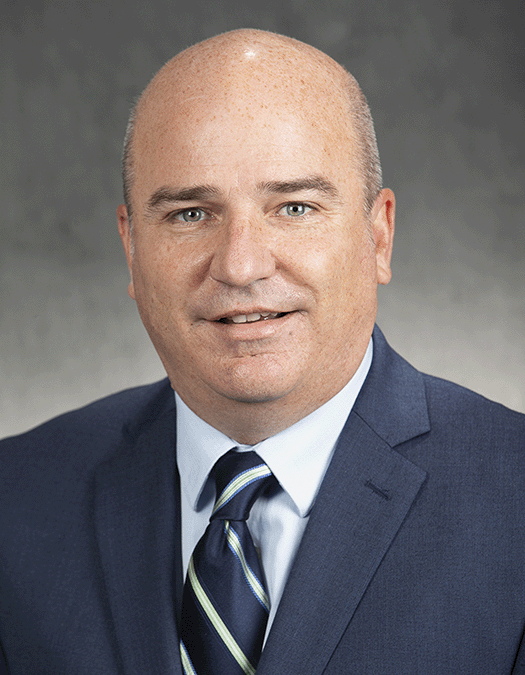
2025-2026 Regular Session Introduced by John Burkel and 9 co-sponsors

Expands consumer-directed budgets for community supports, increases reimbursement for community first services, and creates a retirement fund for Minnesota caregivers.

Committee report, to adopt as amended and re-refer to Taxes
0
WeVote Research Nonpartisan
Bill Summary · HF 2367

Summary — Minnesota HF 2367 (2025-2026 Session)

Purpose and Intent

HF 2367 proposes a package of changes to aftercare and supports for individuals receiving community-based services, with a focus on reimbursement rates for community first services, expansion of consumer-directed community supports budgets, and the creation of a retirement fund for Minnesota caregivers. The bill also contemplates financial appropriations to support these changes. The overarching aim appears to improve access to community-based supports, enhance consumer control over services, and provide retirement savings options for caregivers.

Key Provisions

1) Community First Services and Supports Reimbursement Rates

  • The bill modifies reimbursement rates for “community first services and supports.” While the precise rate changes are not specified in the provided summary, the intent is to adjust compensation to service providers to reflect costs and potentially improve service availability and quality.

2) Consumer-Directed Community Supports Budgets

  • The bill increases the budgets available for consumer-directed community supports. This allows individuals who qualify for certain services (often through waivers or disability programs) to have greater control over how funds are spent to meet their specific needs.
  • By enlarging these budgets, the bill aims to expand flexibility in service planning and potentially broaden the range of eligible services within consumer-directed models.

3) Minnesota Caregiver Defined Contribution Retirement Fund Trust

  • The bill establishes a Minnesota Caregiver Defined Contribution Retirement Fund Trust. This would create a retirement savings vehicle for caregivers, offering a defined contribution framework—likely employer or program contributions, with investment options and distributions according to plan rules.
  • The focus is on ensuring long-term financial security for individuals who provide care, including those who may be underpaid or work as independent providers within the system.

4) Appropriations and Funding

  • The title indicates that money is appropriated to support these changes. Specific appropriation amounts, funding sources, and implementation timelines are not detailed in the provided summary, but funding is a stated component of the bill.

Who Would Be Affected

  • Service Providers: Providers of community first services and supports would see changes to reimbursement rates.
  • Individuals Requiring Community Supports: Recipients and their families who use consumer-directed budgets would experience larger budgets and greater program flexibility.
  • Caregivers: Personal or formal caregivers could benefit from a new retirement fund, enhancing financial security and long-term planning.
  • State Programs: State agencies administering community supports, waivers, and caregiver programs would implement rate changes, budget adjustments, and the new retirement fund structure.

Procedural and Timeline Aspects

  • Introduced / First Reading: March 17, 2025; referred to Human Services Finance and Policy.
  • Committee Action: April 1, 2025 – Authors added; April 3, 2025 – committee reported “to adopt as amended and re-refer to Taxes.”
  • Next Steps: As indicated, the bill moves to a Taxes committee after amendments. Final floor action would depend on subsequent committee referrals, amendments, and passage by both chambers, followed by the governor’s signature (standard legislative process for Minnesota).

Additional Notes

  • The co-sponsors include a broad bipartisan slate, signaling cross-chamber support across several districts.
  • The bill’s specific numeric changes (e.g., exact percentage or dollar changes to rates and budgets, design details of the retirement trust, and funding amounts) are not provided in the summary. For a precise understanding, review the fiscal note, the exact text of the amendments adopted by the committee, and related policy language.

If you’d like, I can pull the bill’s text, fiscal note, or provide a more detailed comparison with current Minnesota statutes to illustrate the exact changes.

Compiled from official sources — confirm details with the bill’s official record.

Sign in to ask a question.