

WeVote

Bill

Bill

HF 896

Certain retired law enforcement officers permitted to carry firearms in schools.

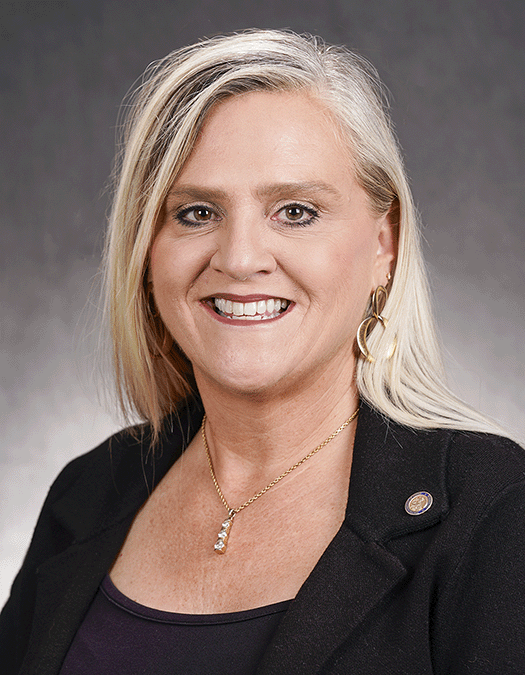
2025-2026 Regular Session Introduced by Pam Altendorf and 6 co-sponsors

The bill allows qualified retired law enforcement officers to carry firearms in schools, with required training, oversight, and district coordination.

Introduction and first reading, referred to Public Safety Finance and Policy
0
WeVote Research Nonpartisan
Bill Summary · HF 896

Summary of HF 896 (2025-2026) – Minnesota

Purpose and Intent

HF 896 proposes to allow certain retired law enforcement officers to carry firearms in schools. The bill sets conditions under which retired officers may be permitted to bring and carry firearms onto school grounds, likely aiming to enhance school safety by leveraging the presence of trained law enforcement personnel within educational environments.

Key Provisions and Changes

  • Eligibility and Permitted Personnel

    • Establishes criteria for which retired law enforcement officers may be authorized to carry firearms in schools. (Exact eligibility criteria are not provided in the summary; the bill would specify who qualifies, such as retirement status, tenure, certification, or other qualifications.)
  • Authorization to Carry in Schools

    • Allows qualified retired officers to carry firearms on school property or within school facilities. The bill would define the scope of “schools” (e.g., school buildings, campuses, or grounds) and may specify related locations such as school-sponsored events or transportation settings.
  • Training and Qualification Requirements

    • Likely requires specific training or refresher requirements for those carrying weapons in schools (e.g., current firearms competency standards, ongoing education, or annual certifications). The exact details would be outlined in the bill.
  • Rules and Oversight

    • Potentially includes provisions for oversight, reporting, and compliance, such as:
    • Verification of retirement status and licensure
    • Documentation or sign-in requirements for schools
    • mechanisms for school districts to adopt or implement the policy
    • penalties or consequences for non-compliance
  • Coordination with School Districts

    • May require or authorize school districts to participate in implementing the policy, including collaboration with local law enforcement agencies.

Who Would Be Affected

  • Retired Law Enforcement Officers

    • Those who meet the eligibility criteria would be permitted to carry firearms in schools under the terms of the bill.
  • Minnesota School Districts and School Personnel

    • District administration, school resource officers (SROs), and staff would be affected through policy implementation, training, safety planning, and compliance processes.
  • Public Safety and Law Enforcement Agencies

    • Agencies would play a role in credentialing, oversight, and coordination with school communities.

Procedural and Timeline Aspects

  • Legislative Path

    • Introduced and assigned to Public Safety Finance and Policy committee on February 17, 2025.
    • The bill is at an early stage of the legislative process; it would require committee consideration, potential amendments, and floor votes in the Minnesota Legislature.
  • Sponsors

    • Primary and co-sponsors include:
    • Jim Joy
    • Natalie Zeleznikar
    • Pam Altendorf
    • Terry Stier
    • Krista Knudsen
    • Jeff Backer
    • Ben Davis
  • Effective Dates (to be specified in the bill)

    • The bill would set effective dates for when the authorization becomes operative, including any applicability to existing retirees or to new retirees and phased implementation if applicable.

Notes

  • Specific statutory text is not provided here, so exact definitions, restrictions, and numerical thresholds (e.g., who qualifies, required training hours, reporting timelines) would be found in the bill’s full language.
  • As introduced, the bill’s core policy question concerns balancing school safety with concerns about firearm presence in schools, along with administrative feasibility and local district implementation.

If you’d like, I can pull the bill’s full text or analyze potential fiscal impacts, implementation challenges, or public safety considerations once you provide the official bill language or a more detailed summary.

Compiled from official sources — confirm details with the bill’s official record.

Sign in to ask a question.