

WeVote

Bill

Bill

HF 1405

Campaign reporting requirements amended to require disclosure of all contributors for legislative or statewide candidates and ballot questions.

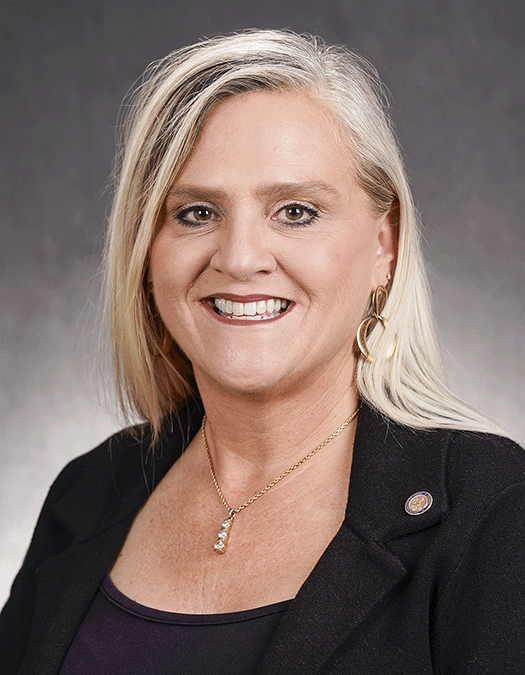
2025-2026 Regular Session Introduced by Pam Altendorf and 2 co-sponsors

The bill would require campaigns for legislative or statewide offices and ballot questions to disclose all contributors, expanding transparency of funding sources.

Introduction and first reading, referred to Elections Finance and Government Operations
0
WeVote Research Nonpartisan
Bill Summary · HF 1405

Summary of HF 1405 (2025-2026) — Minnesota

Overview

HF 1405 proposes amendments to campaign reporting requirements to mandate disclosure of all contributors for campaigns supporting or opposing legislative or statewide candidates and ballot questions. The bill aims to increase transparency in political financing by ensuring that a complete record of contributors is publicly disclosed.

  • Session: 2025-2026
  • Jurisdiction: Minnesota
  • Title: Campaign reporting requirements amended to require disclosure of all contributors for legislative or statewide candidates and ballot questions
  • Introduced/Referral: 2025-02-24, referred to Elections Finance and Government Operations
  • Co-sponsors: Pam Altendorf; Joe McDonald; Jimmy Gordon

Purpose and Intent

  • Improve transparency in campaign finance by requiring disclosure of all contributors (not just certain categories or aggregate totals) for campaigns related to legislative or statewide candidates and ballot questions.
  • Strengthen the public’s ability to track funding sources and understand the breadth of financial support behind campaigns.

Key Provisions (as described)

Note: The exact statutory text is not provided here, but the following provisions are typically associated with this type of reform. Please consult the bill’s language for precise details.

  • Expanded Contributor Disclosure: Campaigns for legislative or statewide candidates and ballot questions must disclose all contributors, potentially including:
    • Individual donors
    • Political action committees (PACs) and other political committees
    • Ownership entities or affiliated groups that contribute to the campaign
    • Any intermediaries through which contributions are channeled
  • Public Reporting Requirements: The bill would specify reporting timelines and formats to ensure timely and accessible disclosure, likely updating the state’s campaign finance reporting portal or similar mechanism.
  • Thresholds and Aggregation Rules: The bill might address whether small donors are itemized (per contributor) or aggregated; it may set thresholds for when contributions must be itemized versus reported in aggregate.
  • Beneficial Ownership/Control Disclosure (possible): Provisions could require disclosure of individuals or entities with significant control or beneficial ownership over contributing committees or entities.
  • Compliance and Enforcement: Provisions outlining penalties or corrective actions for noncompliance, including audits, investigations, or fines.

Affected Entities

  • Campaigns for Legislative or statewide office: Candidates and their campaign committees
  • Campaigns for ballot measures: Committees supporting or opposing statewide ballot questions
  • Contributors: Individuals and organizations that donate to these campaigns
  • Campaign Finance Administrators: State election officials and the agency/office responsible for monitoring compliance and maintaining disclosure databases

Procedural and Timeline Aspects

  • Introduction and Referral: February 24, 2025, to Elections Finance and Government Operations committee
  • Progression: As a bill in the 2025-2026 session, it would proceed through standard committee hearings, potential amendments, floor votes in the House, and companion actions in the Senate (if applicable).
  • Implementation Timing (typical): If enacted, the effective date and any phase-in period would be specified in the bill, often with a future effective date for campaigns filing after enactment or a transition period for existing filings.

Potential Impacts and Considerations

  • Transparency vs. Privacy: Broader disclosure may raise questions about donor privacy and data handling. The bill would need to balance public transparency with reasonable privacy protections.
  • Administrative Burden: Campaigns may incur additional reporting requirements and administrative work to compile complete contributor lists.
  • Enforcement Resources: State agencies would require resources to monitor, verify, and enforce the expanded disclosures.

Notes

  • The summary reflects typical elements associated with expanded contributor disclosure bills. For precise requirements (itemization rules, thresholds, reporting timelines, penalties), refer to the exact text of HF 1405 and any floor amendments.

Compiled from official sources — confirm details with the bill’s official record.

Sign in to ask a question.